May 25, 2026 · MattressQuiz.co
Best Mattress for Side Sleepers: What Your Shoulders and Hips Actually Need (2026)
More than 60% of adults sleep on their side. Here's the physics of why side sleeping is the most demanding position for a mattress, and which mattresses handle it best in 2026.
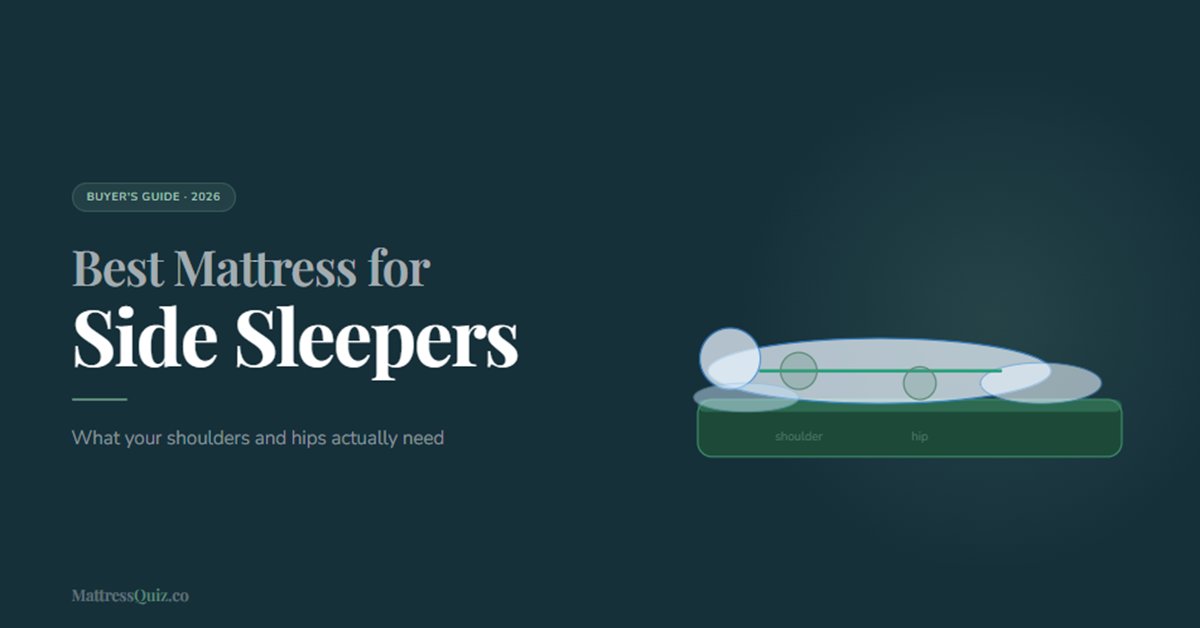
More than 60 percent of adults sleep primarily on their side. It’s the most common sleep position, it reduces snoring, and it’s generally recommended during pregnancy. It also creates the most specific demands of any sleep position on a mattress.
Side sleeping places the body’s weight on two contact points: the hip and the shoulder.
Those two joints bear the pressure load that back sleeping distributes across the entire spine. Get the mattress wrong and those pressure points wake you up during the night. Get it wrong consistently and you develop shoulder tension or hip pain that’s difficult to trace back to its actual cause.
The challenge is that side sleepers need a mattress that does two things simultaneously, and those two things pull in opposite directions. The shoulder needs to sink in far enough to keep the spine neutral.
The hip needs enough pushback to prevent it from dropping below the spine line. Too soft and the hip sags. Too firm and the shoulder stacks against the surface and the spine bows laterally.
Most mattress guides tell you to buy soft to medium for side sleeping and leave it there. That’s incomplete advice, and for a lot of side sleepers it produces the wrong result.
This guide explains the actual mechanics, what the mattress needs to do for your specific body, and which mattresses from our lineup handle it well.
Why Side Sleeping Is Hard on the Wrong Mattress
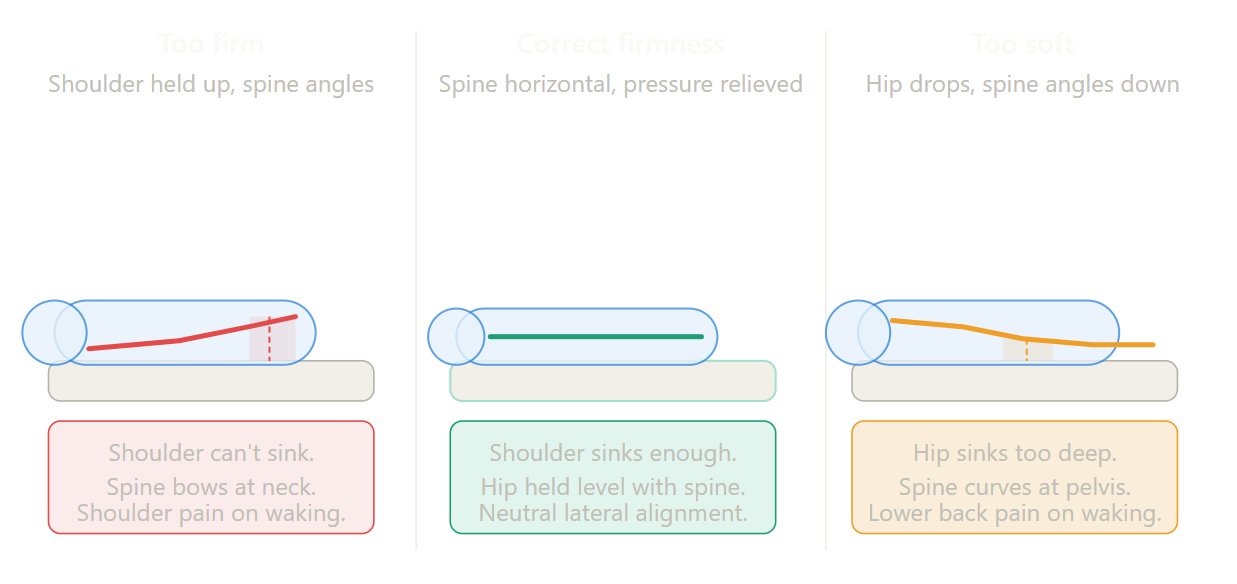
When you lie on your side, your spine needs to form a straight horizontal line from your neck to your tailbone. Two things prevent this from happening.
If the mattress is too firm: The shoulder cannot sink into the surface. It stays elevated, which creates an upward bow in the spine at the shoulder. After several hours in this position, the muscles on the compressed side of the neck and upper back stay under tension. You wake up with shoulder stiffness or upper back soreness that you can’t trace to anything specific.
If the mattress is too soft: The hip sinks too deeply into the surface, dropping below the shoulder line. The spine curves laterally at the lumbar. This is the same mechanism as lower back pain caused by insufficient lumbar support in back sleeping, but from a different direction. It produces hip pain and lower back tension specifically on the side you sleep on.
The correct mattress for side sleeping allows the shoulder to sink enough to form a neutral spine without allowing the hip to drop past that neutral point. That balance point is different for every body depending on shoulder width, hip width, and body weight.
The Shoulder Sinkage Equation
Here is the specific thing most guides skip: shoulder width matters for mattress selection in a way that almost no guide addresses.
A broader-shouldered sleeper needs a deeper shoulder sink to keep the spine neutral. A narrower-shouldered sleeper reaches neutral alignment with a shallower sink. This means two people with the same body weight can need different mattress firmness levels based on shoulder width alone.
Broader shoulders require a slightly softer comfort layer, because the shoulder needs to sink further before the spine straightens.
Narrower shoulders reach alignment with less sink, which means a firmer comfort layer still works.
This is most relevant for men with broad shoulders, who often find that mattresses marketed as “ideal for side sleepers” still feel too firm. The standard medium recommendation is calibrated for average shoulder width. If you’re broader than average, go half a step softer than the standard recommendation suggests.
Firmness for Side Sleepers: The Weight-Adjusted Reality
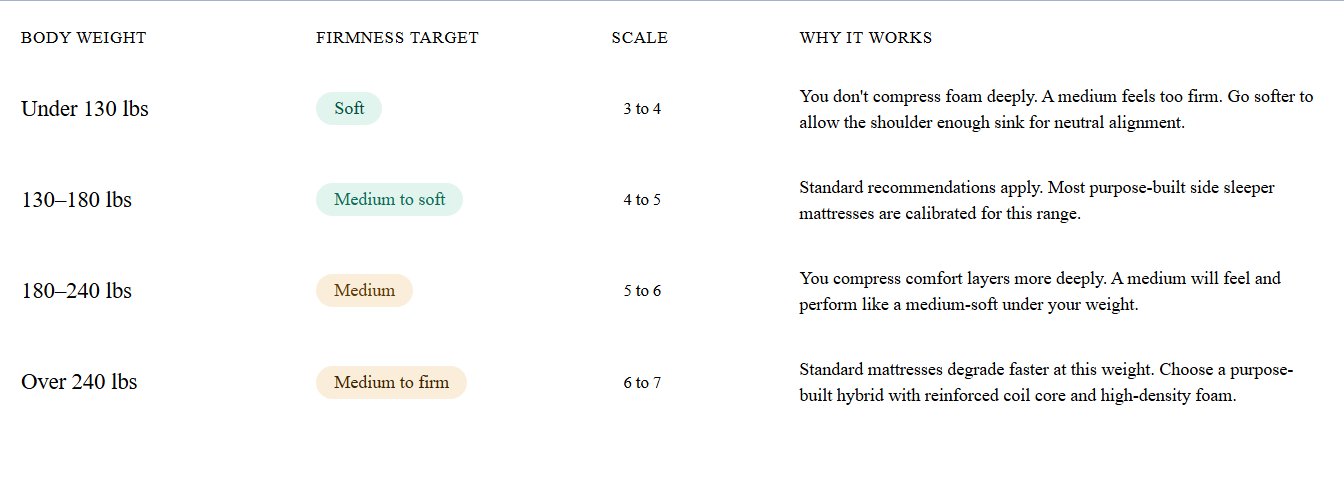
Standard firmness advice for side sleepers is soft to medium, approximately 3 to 5 on the 10-point scale. This applies reasonably well to average-weight sleepers between 130 and 180 pounds. Outside that range, the advice needs adjustment.
Under 130 lbs: You generate less force against the mattress surface. A mattress rated as medium will feel firmer to you than to a heavier person. Side sleepers under 130 lbs should be looking at soft (3-4) rather than medium. The Nectar Premier Copper at medium-soft is a natural starting point.
130-180 lbs: Standard advice applies. Medium to medium-soft (4-5) covers most profiles in this range.
180-240 lbs: You compress comfort layers more deeply than a lighter sleeper, which means a medium mattress quickly feels like a medium-soft once body heat and weight do their work. Start at medium-firm (5-6) and let the compression work in your favour. The Helix Midnight at medium is designed for this: it feels like a true medium to average-weight sleepers and a softer medium to heavier ones due to compression.
Over 240 lbs: Standard side sleeper recommendations are unreliable. Most medium mattresses will sag at the hip within months under higher body weight, creating the lumbar problem described above. You need a purpose-built construction with a reinforced coil core. Nolah Evolution 15 with its heavy-duty 15-inch profile is the most relevant option from our lineup at this weight range.
What to Look for in a Mattress as a Side Sleeper
Comfort layer depth matters more than for any other position. A thin comfort layer on an otherwise supportive mattress will not allow the shoulder to sink enough. Look for at least 2-3 inches of comfort layer. Most quality mid-range hybrids meet this threshold. Budget mattresses often don’t.
Pocketed coil hybrids outperform all-foam for most side sleepers. The coil core provides consistent support under the hip while the foam comfort layer handles the shoulder. All-foam mattresses can provide excellent shoulder pressure relief but tend to allow more hip sinkage over time as foam compresses.
Zoned support is a genuine advantage for side sleepers. Some mattresses use different coil gauges or foam densities in different zones, with a softer zone under the shoulders and firmer support under the hips and lumbar. This directly addresses the shoulder-hip balance problem. The Casper Wave Hybrid and Helix Midnight both use this principle.
Avoid coil gauges that are too heavy in the comfort zone. This is a construction detail most buyers never see, but it’s why some mattresses marketed for side sleepers still feel too firm at the shoulder. A coil system that runs all the way to the surface without adequate foam on top will hold the shoulder up regardless of how soft the foam layer above feels initially.
The Best Mattresses for Side Sleepers
These are our recommendations from our lineup, matched to different side sleeper profiles.
Helix Midnight: Best Overall for Side Sleepers
The Helix Midnight is purpose-built for side sleepers and it earns that positioning. The 2.5-inch comfort layer is specifically tuned for shoulder and hip pressure relief, and the medium firmness level (5/10) hits the balance point for most average-weight side sleepers.
What separates the Midnight from a generic medium hybrid is the construction of the comfort layer. It uses a specific combination of foam densities that contour to the shoulder more aggressively than the hip, which naturally produces better lateral spinal alignment for side sleeping without a user needing to understand any of this.
It consistently performs best for side sleepers in the 130-230 lb range. Outside this range, look at the alternatives below.
Best for: Side sleepers 130-230 lbs, combo sleepers who spend most time on their side, hip and shoulder pressure relief, upper back pain from side sleeping. Queen price: $1,099-$1,332. Trial: 100 nights.
DreamCloud Hybrid: Best Value for Side Sleepers
The DreamCloud is our default recommendation for most US sleeper profiles, and it performs well for average-weight side sleepers specifically because of how the Euro-top comfort layer interacts with the pocketed coil core.
The Euro-top provides genuine shoulder pressure relief, and the coil core underneath keeps the hip supported at the right level. At medium-firm (6/10), it sits slightly on the firmer side of the side sleeper range, which makes it a better fit for side sleepers between 150-240 lbs rather than lighter ones.
Its 365-night trial is the longest on this list, which gives lighter side sleepers who find it slightly too firm the time to make a proper assessment before committing.
Best for: Side sleepers 150-240 lbs, combo sleepers, buyers who want the longest trial period available, budget-conscious buyers. Queen price: $649-$1,299. Trial: 365 nights.
Nectar Premier Copper: Best for Side Sleepers Who Want Foam Feel
For side sleepers who specifically want the enveloping feel of memory foam rather than the more responsive hybrid feel, the Nectar Premier Copper is the strongest option in our lineup.
The copper-infused memory foam comfort layer provides deep shoulder contouring that foam-top hybrids generally don’t match. The plush feel is genuinely well-suited to lighter side sleepers and those with significant shoulder or hip pressure pain.
The main limitation is body weight. Above 210 lbs, the memory foam comfort layer allows the hip to sink deeper than is ideal for spinal alignment. At this weight and above, the hybrid options are more reliable.
Best for: Side sleepers under 210 lbs who prefer foam feel, significant hip or shoulder pressure pain, cool to neutral sleepers who want foam contouring without the heat problem all-foam creates. Queen price: $799-$999. Trial: 365 nights.
Purple RestorePlus: Best for Side Sleepers Who Sleep Hot
Hot sleeping and side sleeping is one of the more difficult combinations to solve with a single mattress. Side sleeping creates maximum body contact with the surface, which intensifies the heat trapping that foam construction produces. Most side sleeper recommendations make no accommodation for this.
The Purple RestorePlus solves it at a structural level. The GelFlex Grid creates thousands of air channels directly at the sleeping surface, which prevents the heat accumulation that foam causes regardless of what additives it contains. For a side sleeper who wakes up hot, this is the construction that actually addresses the problem rather than softening it.
The grid is also position-neutral in terms of pressure relief, which means it handles the shoulder-hip balance for side sleeping without requiring zone-specific construction.
Best for: Side sleepers who sleep hot, combo sleepers, 130-230 lbs, severe heat issues. Queen price: $2,499-$2,999. Trial: 100 nights (note: returns now carry a $250 fee following Purple’s 2025 policy change).
Nolah Evolution 15: Best for Heavy Side Sleepers
Side sleepers over 230 lbs face a specific problem: standard mattresses do not maintain their pressure relief and support properties at higher weight ranges over time. The hip compresses the comfort layer too aggressively, and the result is a mattress that felt right in the first month and becomes progressively worse over the following year.
Nolah Evolution 15 was designed for heavier sleepers. The 15-inch profile includes a heavier-duty coil core and a high-density AirFoamICE comfort layer that maintains its properties under sustained higher-weight compression. For heavy side sleepers who have gone through this cycle of mattresses that felt right and then degraded, this is the correct starting point.
The Plush firmness option is the right choice for side sleepers at this weight range.
Best for: Side sleepers over 180 lbs, particularly 200-300+ lbs, back and side combo sleepers with back pain at higher weights. Queen price: $1,099-$1,299. Trial: 120 nights.
Side Sleepers with Shoulder Pain
Shoulder pain from side sleeping is almost always caused by a mattress that is too firm for your shoulder width and body weight.
The shoulder is held at the surface rather than being allowed to sink into the comfort layer. The surrounding muscles compensate through the night and present as pain or stiffness in the morning.
If you sleep on your right side and wake up with right shoulder pain, or left side and left shoulder pain, the mattress is almost certainly the cause.
The solution is a softer comfort layer, not a softer mattress overall. A mattress with good zoned support, softer at the shoulder and firmer at the hip, resolves this without requiring you to go to a mattress that’s too soft for lumbar support. Helix Midnight and Casper Wave Hybrid address this with zone-specific construction.
If you’ve tried a softer mattress and the shoulder pain persists, a pillow problem may be contributing. Side sleeping requires a pillow with enough loft to fill the space between your shoulder and your ear. A flat pillow drops the head and creates cervical tension that presents as shoulder pain. This is worth checking before buying a new mattress.
Side Sleepers with Hip Pain
Hip pain from side sleeping is caused by a mattress that is either too firm or, in some cases, too soft for your body weight.
Too firm: the hip is held at the surface with concentrated pressure on the greater trochanter, the bony protrusion at the side of the hip. This presents as a dull ache on the side you sleep on.
Too soft: the hip sinks below the spine line and the lumbar is forced into a lateral curve. This presents as both hip pain and lower back tightness on the same side.
Distinguishing between the two: if a firmer surface helps and a softer surface makes it worse, you have the too-soft problem. If a softer surface helps and a firmer surface makes it worse, you have the too-firm problem.
For the too-firm hip pain in an average-weight sleeper, the Helix Midnight or Nectar Premier Copper are the most targeted solutions. For heavier sleepers with hip pain, the Nolah Evolution 15 in Plush option handles the weight-adjusted pressure relief correctly.
What Side Sleepers Should Avoid
Extra firm mattresses regardless of marketing claims. Some mattresses marketed for back pain or stomach sleeping are listed as options for side sleepers in certain guides. Extra firm construction does not allow the shoulder to sink and will create shoulder pain for most side sleepers.
Very thin comfort layers on otherwise supportive mattresses. A coil mattress with less than 1.5 inches of comfort layer will hold the shoulder regardless of the coil softness underneath. The comfort layer is what the shoulder contacts first and needs to sink into.
Budget all-foam mattresses for heavier side sleepers. Budget foam without adequate density will compress at the hip over time and create progressive alignment problems. At over 180 lbs and a budget under $700, Allswell Hybrid is a more durable option than most all-foam alternatives at the same price.
Frequently Asked Questions
What firmness is best for side sleepers?
Soft to medium, approximately 3 to 5 on the 10-point scale, for average-weight sleepers (130-180 lbs). Lighter side sleepers (under 130 lbs) should go softer, around 3-4. Heavier side sleepers (180-240 lbs) should start at medium, around 5-6, because they compress comfort layers more deeply. Over 240 lbs, a purpose-built hybrid at medium-firm (6) is more reliable than a standard medium.
Is memory foam or hybrid better for side sleepers?
Both work well for side sleepers. Memory foam provides deeper shoulder contouring and is better for lightweight side sleepers with significant pressure pain. Hybrids provide better cooling, more consistent long-term support, and are more reliable for heavier side sleepers. For most side sleepers, a hybrid with a well-designed foam comfort layer is the better all-around choice.
What is the best mattress for side sleepers with back pain?
A hybrid with zoned support, softer under the shoulders and firmer under the lumbar and hips. This addresses the shoulder pressure relief that side sleeping requires while preventing the hip sag that causes lower back pain. Helix Midnight (medium) and Casper Wave Hybrid are the most targeted options for this combination.
Can a mattress cause shoulder pain?
Yes, and it’s one of the most common causes of unexplained shoulder pain. A mattress that is too firm for a side sleeper holds the shoulder against the surface and keeps the surrounding muscles under tension through the night. If your shoulder pain is specifically on the side you sleep on and is worse in the morning, the mattress is the most likely cause.
How do I know if my mattress is too firm for side sleeping?
Lie on your side and have someone look at your spine from behind. If there is a visible upward curve at your shoulder or neck, the mattress is too firm. Alternatively, if you wake up with shoulder or hip pain that was not present when you went to sleep and improves as you move around, the mattress is too firm or creating pressure in the wrong place.
Find Your Match
The recommendations above cover the most common side sleeper profiles. Your exact ideal mattress also depends on whether you share the bed, your heat sensitivity, and any specific health conditions.
Our mattress quiz factors all of this in and gives you a personalised recommendation in about two minutes.
[Take the free quiz at MattressQuiz.co]
Affiliate disclosure: Some links in this article are affiliate links. We earn a small commission if you purchase through them at no extra cost to you. It never influences which products we recommend.
Mattress quiz finder
Find the mattress that fits you
Answer a few questions about how you sleep. Get scored matches from our catalog—not a generic roundup.
Start the free quiz