May 14, 2026 · MattressQuiz.co
Best Mattress for Back Pain: How to Find the Right One for Your Specific Situation (2026)
The best mattress for back pain depends on where it hurts, how you sleep, and how much you weigh. Here's the framework most guides skip, plus specific recommendations for lower back, upper back, and sciatica.
You switch to a firmer mattress. The back pain stays. You go firmer still. It gets worse.
This is one of the most common patterns in mattress buying, and it comes from a piece of advice that has circulated for decades: firm is better for your back.
The research does not support this. And for a significant number of people, going firmer actively makes back pain worse.
The problem is not firmness. The problem is that most people buy a mattress without understanding what their specific type of back pain actually needs from a sleep surface. Lower back pain and upper back pain need different things.
A side sleeper with back pain needs a different mattress than a back sleeper with back pain. And a 220-pound person needs a different construction than a 150-pound person with the same diagnosis.
This guide gives you the framework to match a mattress to your specific situation, explains what the research actually says about firmness and back pain, and recommends specific mattresses from our lineup based on pain type, sleep position, and body weight.
Why Your Mattress Could Be Making Your Back Pain Worse
Not all back pain is caused by a mattress. But if you regularly wake up with pain that was not there when you went to sleep, or if your pain is noticeably worse in the morning and improves as you move around during the day, the mattress is a very likely contributor.
Two mechanisms cause or worsen back pain during sleep.
Insufficient support. When the mattress allows the midsection to sink below the rest of the body, it takes the spine out of its neutral alignment. The muscles that support the spine stay partially contracted through the night trying to compensate, and you wake up with lower back tension or pain. This is most common on mattresses that are too soft for your body weight.
Excess pressure. When the mattress is too firm for your sleep position, it holds the spine rigid against the surface rather than allowing the natural curves to be supported. For side sleepers, this creates a lateral curve at the hip. For back sleepers with certain body types, it concentrates pressure at the lumbar. The pain presents differently from support-based pain but is just as common.
The key insight is that these two problems require opposite solutions. Most people treat all back pain as a support problem and go firmer. Half of them are making the pressure problem worse.
The Research on Firmness and Back Pain
A landmark randomised controlled trial published in The Lancet assessed 313 adults with chronic lower back pain across medium-firm and firm mattresses over 90 days. Medium-firm produced significantly better outcomes on both pain scores and disability measures. The firm mattress group showed no advantage.
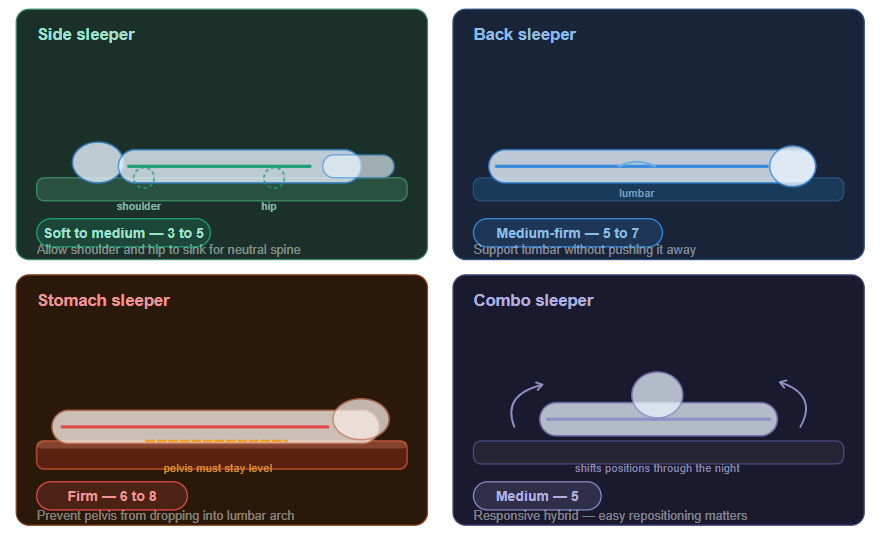
Subsequent studies have confirmed the same pattern: medium-firm is the most evidence-supported firmness level for back pain. Not firm. Not extra firm. Medium-firm, which is approximately 5.5 to 6.5 on the standard 10-point scale.
The reason is straightforward. Medium-firm provides enough pushback to prevent lumbar sag while allowing enough contouring to prevent the concentrated pressure that firm surfaces create. It serves both mechanisms at once.
This does not mean medium-firm is right for everyone with back pain. It means it is the best starting point, and your body weight and sleep position will refine that starting point in either direction.
Lower Back Pain vs Upper Back Pain: What Each Needs
Most back pain guides treat all back pain the same. They should not.
Lower back pain
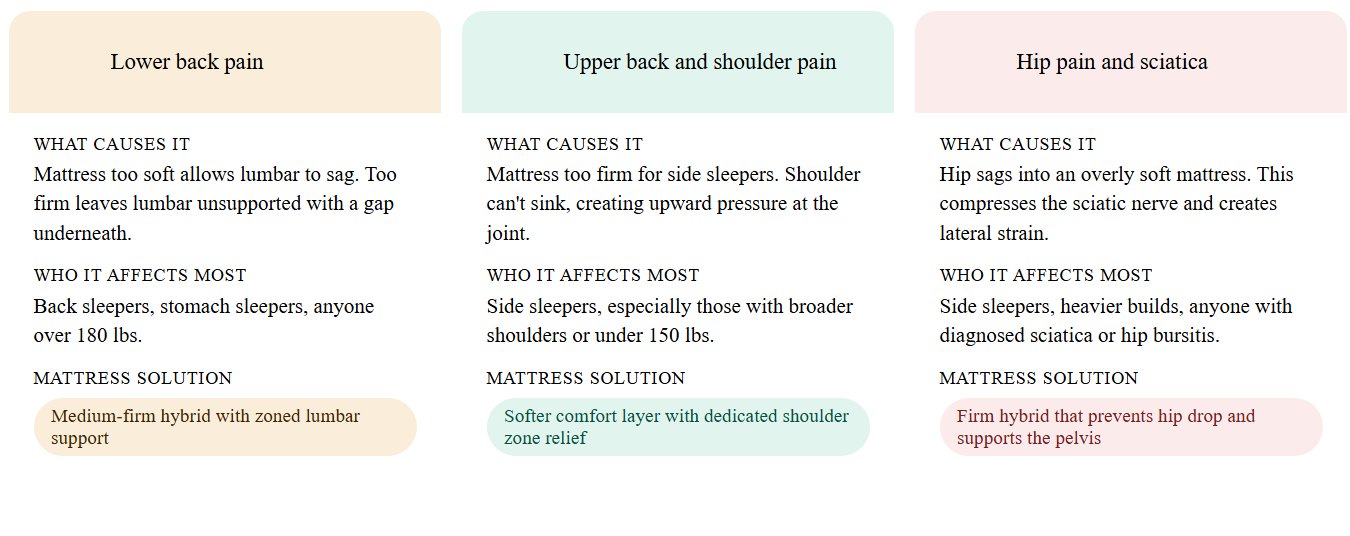
Lower back pain during sleep is almost always a support problem. The lumbar spine needs to stay in its natural gentle curve overnight. When a mattress is too soft, the hips sink and the lumbar flattens or reverses into flexion. When a mattress is too firm, the lumbar is held away from the surface with no support underneath it.
The solution is a mattress with a firm support core and a comfort layer soft enough to allow the hips to settle into a natural position. Zoned support systems, where the coils in the lumbar region are slightly firmer than those under the shoulders, address this specifically. WinkBed and Saatva Classic both use this construction.
Best sleep position for lower back pain: Back sleeping on a medium-firm surface. Side sleeping with a pillow between the knees.
Upper back and shoulder pain
Upper back and shoulder pain during sleep is almost always a pressure problem. The thoracic spine and shoulder area needs cushioning, not rigidity.
A mattress that is too firm for a side sleeper will hold the shoulder and hip at the surface and create a lateral bow in the spine. Over several hours, this produces upper back tension and shoulder pain that is often mistaken for a rotator cuff issue.
The solution is a softer comfort layer with good pressure relief at the shoulder and hip, over a support core that keeps the spine from collapsing. Zoned mattresses that are softer at the shoulder zone and firmer at the lumbar zone address this directly.
Best sleep position for upper back pain: Side sleeping with a mattress that has genuine shoulder pressure relief.
Sciatica
Sciatica is caused by compression or irritation of the sciatic nerve, which runs from the lower back through the hips and down each leg. Mattress-related sciatica flare-ups are almost always caused by the hips sinking into an overly soft surface and compressing the nerve.
The priority for sciatica is preventing hip sag. A medium-firm to firm hybrid with good lumbar zoning is the most reliably helpful construction. WinkBed (Firmer option) and Nolah Evolution 15 both perform well here.
How Body Weight Changes Everything
As covered in our firmness guide, body weight changes how a mattress actually feels and performs.
A 150-pound back sleeper and a 240-pound back sleeper both need lumbar support. But they need it from different constructions.
The lighter sleeper does not compress comfort layers deeply, so a medium-firm mattress provides the right balance of give and pushback. The heavier sleeper compresses through the comfort layer more aggressively, which means a medium-firm mattress will feel soft and will allow lumbar sag within a few months as the foam compresses.
Under 150 lbs with back pain: Medium (5-6). You do not need aggressive firmness. Your lower weight means you are more at risk of a too-firm mattress creating pressure than a too-soft mattress creating sag.
150-200 lbs with back pain: Medium-firm (6-7). Standard recommendations apply well to this range.
200-250 lbs with back pain: Firm (7-8). You need a purpose-built construction. Standard medium-firm mattresses will compress faster and feel softer than their rating suggests under your weight.
Over 250 lbs with back pain: Firm to extra firm (7-9) with a mattress specifically built for heavier sleepers. Nolah Evolution 15 and WinkBed Plus are the relevant options from our lineup.
The Best Mattresses for Back Pain
These are our recommendations from our affiliate lineup, matched to specific back pain profiles.
WinkBed: Best Overall for Back Pain
The WinkBed is our top recommendation for most back pain sufferers because it addresses the problem at a structural level.
Its zoned pocketed coil system uses thicker, firmer coils in the lumbar zone and softer coils under the shoulders. This is not a marketing claim. The coil gauge actually differs across zones, which means the mattress genuinely supports the lower back more firmly while allowing the shoulders to sink into the comfort layer. No single-firmness mattress can do this.
It comes in four options: Softer, Medium, Firmer, and Plus (for sleepers over 300 lbs). For most back pain profiles, Firmer is the starting recommendation. For side sleepers with back pain, Medium is the better choice. The ability to select the right construction for your specific profile is what separates WinkBed from most competitors.
Made in the US with a lifetime warranty. Returns work but check current policy before purchasing.
Best for: Back sleepers, stomach sleepers, heavier back pain sufferers (150-300+ lbs), sciatica, lower back pain. Queen price: $1,499-$1,799. Trial: 120 nights.
Saatva Classic: Best for Chronic Back Pain
The Saatva Classic is the only mattress in our lineup with Lumbar Zone Quilting, a patented system that places a firmer foam pad in the lumbar section of the mattress cover. Combined with its dual coil system, this creates additional support specifically where chronic back pain sufferers need it most.
It also includes a pillow-top comfort layer, which means it provides lumbar support without the uncomfortable rigidity that many firm mattresses produce. This is the hotel-quality feel that still supports the back properly.
The three firmness options (Plush Soft, Luxury Firm, and Firm) cover the range from side sleepers with back pain to stomach sleepers. Luxury Firm is the most recommended for back pain and sits at approximately 5.5-6 on the scale.
White-glove delivery and setup is included. They also remove your old mattress if needed.
Best for: Back sleepers, chronic lower back pain, sleepers who want hotel-quality feel with genuine back support, 130-280 lbs. Queen price: $1,595-$1,795. Trial: 365 nights.
Casper Wave Hybrid: Best for Side Sleepers with Back Pain
The Casper Wave Hybrid is specifically engineered for the problem of side sleeping with back pain. Its five-zone design is softer under the shoulders and firmer under the lumbar and hips. Where most zoned mattresses vary the support core, the Wave Hybrid varies the entire comfort system by zone.
This means a side sleeper gets the shoulder pressure relief they need to prevent upper back and shoulder pain, while the firmer lumbar zone prevents the hip sag that triggers lower back pain. It is the only mattress in our lineup that specifically addresses both sides of the side-sleeping back pain equation simultaneously.
One honest caveat: it is expensive for the features provided. If budget is a constraint, WinkBed in the Medium option is a more cost-effective solution for side sleepers with back pain.
Best for: Side sleepers with back pain, upper back and shoulder pain, 120-220 lbs. Queen price: $2,295-$2,895. Trial: 100 nights.
Nolah Evolution 15: Best for Heavier Sleepers with Back Pain
For anyone over 180 lbs with back pain, standard mattress recommendations are unreliable. Most mattresses are not built to maintain their support properties at higher weights over time. Nolah Evolution 15 is.
Its 15-inch profile with a heavy-duty zoned coil core and high-density AirFoamICE comfort layer was built specifically for heavier sleepers. The coil system in the lumbar zone is reinforced to prevent the compression that causes back pain in heavier builds. The three firmness options cover side, back, and combination sleepers.
It is also one of the few mattresses in this price range that specifically covers the body weight segment most guides ignore.
Best for: Sleepers over 180 lbs with back pain, back and side sleepers with chronic lower back issues. Queen price: $1,099-$1,299. Trial: 120 nights.
DreamCloud Hybrid: Best Budget Option for Back Pain
The DreamCloud is not purpose-built for back pain the way WinkBed and Saatva are. It does not have zoned lumbar support. But it is a high-quality hybrid with a pocketed coil support core, and for mild to moderate back pain in average-weight sleepers, that coil construction provides meaningful support at a significantly lower price.
Its 365-night trial also makes it the lowest-risk purchase on this list. If the back pain does not improve within a few months, you have nearly a year to return it.
For severe or chronic back pain, invest in WinkBed or Saatva. For mild morning stiffness or occasional back discomfort, DreamCloud at $649-$1,299 is a reasonable starting point.
Best for: Mild back pain, 130-240 lbs, back and combo sleepers, budget-conscious buyers. Queen price: $649-$1,299. Trial: 365 nights.
What to Avoid if You Have Back Pain
All-foam mattresses without zoned support. General memory foam conforms to your body but does not push back where it needs to. For back pain sufferers, the lumbar sag that develops over time on unsupported foam is a consistent problem.
Going extra firm because “firm is better for your back.” As covered above, the research does not support this. Extra firm creates pressure problems, particularly for side sleepers, and can create a different type of back pain.
Budget innerspring mattresses. These lack the comfort layer depth to prevent pressure points and the coil sophistication to provide zoned support. They are fine for guest rooms and short-term use. They are not reliable for ongoing back pain management.
Replacing a firm mattress with an equally firm mattress. If your current firm mattress is contributing to your back pain, buying another firm mattress in a different brand is unlikely to change the outcome. The construction category matters more than the brand.
A Quick Decision Framework
Lower back pain, back sleeper: WinkBed (Firmer) or Saatva Classic (Luxury Firm). Zoned lumbar support is the priority.
Upper back or shoulder pain, side sleeper: Casper Wave Hybrid or WinkBed (Medium). Softer shoulder zone with firm lumbar is the target construction.
Sciatica: WinkBed (Firmer) or Nolah Evolution 15. Preventing hip sag is the critical factor.
Heavy build (180+ lbs) with back pain: Nolah Evolution 15. Standard mattresses are not built for your weight range.
Mild morning stiffness, average weight: DreamCloud Hybrid. Coil support at a reasonable price with a long trial.
Chronic or severe back pain: Saatva Classic. Lumbar Zone Quilting plus dual coil system plus white-glove setup is the most complete solution.
Frequently Asked Questions
What mattress firmness is best for back pain?
Medium-firm (5.5-6.5 on the 10-point scale) is the most research-supported starting point for most back pain sufferers. A randomised controlled trial published in The Lancet found medium-firm produced significantly better outcomes than firm over 90 days. Your ideal firmness will shift based on your body weight and sleep position — heavier sleepers and stomach sleepers typically need firmer, lighter side sleepers often need softer.
Is a firm mattress better for a bad back?
Not necessarily. The research actually points to medium-firm as the most effective firmness for back pain, not firm. Going too firm can create pressure points that generate a different type of back pain, particularly for side sleepers. The right firmness depends on where your pain is, how you sleep, and how much you weigh.
Can the wrong mattress cause back pain?
Yes. A mattress that is too soft for your weight allows the midsection to sag overnight, which takes the lumbar spine out of neutral alignment. A mattress that is too firm holds the spine rigidly against the surface and creates pressure at the hip and shoulder. Both produce back pain. The direction of the pain can help identify which problem you have.
What type of mattress is best for lower back pain?
A medium-firm to firm hybrid with zoned lumbar support. The coil core provides the pushback that prevents lumbar sag, and the zoning means the lumbar zone is specifically reinforced while the shoulder and hip zones are softer. WinkBed and Saatva Classic both use this construction.
What mattress is best for back pain and side sleeping?
A hybrid with a softer shoulder zone and firmer lumbar zone. Side sleeping places the hip and shoulder under significant pressure, so the mattress needs to relieve that pressure while maintaining lumbar support. The Casper Wave Hybrid is specifically engineered for this combination. WinkBed in the Medium option is a more affordable alternative.
Does sleeping position matter as much as mattress firmness for back pain?
Both matter and they interact with each other. Back sleeping generally causes the least spinal stress and works well with medium-firm. Side sleeping with a supportive hybrid and a pillow between the knees is the best position for people who cannot sleep on their back. Stomach sleeping is the most stressful position for the lower back and should be avoided if possible.
Find Your Specific Match
The recommendations above cover the most common back pain profiles. But the exact right mattress also depends on your budget, whether you share the bed, your heat sensitivity, and other health conditions you might have.
Our mattress quiz asks about all of this and gives you a personalised recommendation in about two minutes.
[Take the free quiz at MattressQuiz.co]
Affiliate disclosure: Some links in this article are affiliate links. We earn a small commission if you purchase through them at no extra cost to you. It never influences which products we recommend.
Mattress quiz finder
Find the mattress that fits you
Answer a few questions about how you sleep. Get scored matches from our catalog—not a generic roundup.
Start the free quiz