May 12, 2026 · MattressQuiz.co
Hybrid vs Memory Foam Mattress: Which Is Better for You? (2026)
A direct comparison of hybrid vs memory foam mattresses. Who wins for cooling, back pain, motion isolation, and durability — and which type is right for your specific sleep profile.
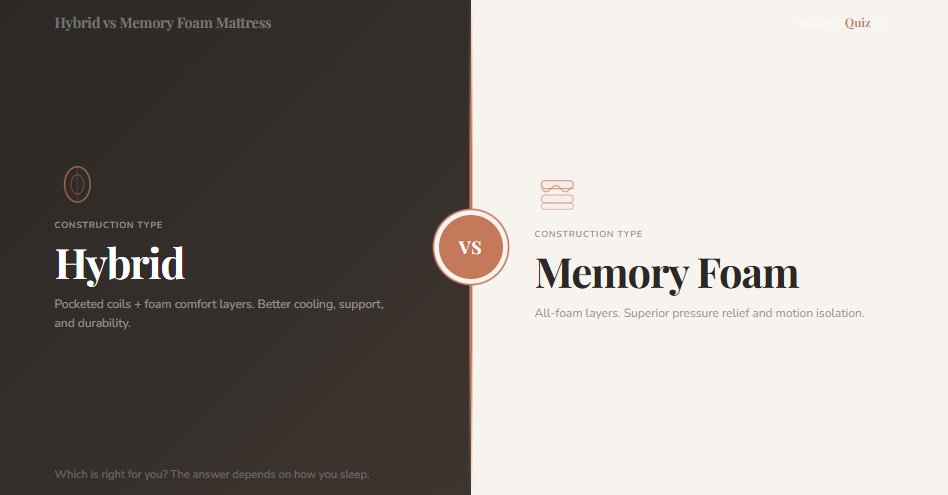
You lie down on memory foam for the first time. It wraps around your body completely, cradles every pressure point, and feels unlike anything you’ve slept on before. It’s remarkable.
Two hours later you’re kicking off the covers because you’re overheating.
That’s the most common memory foam story. And it’s largely why hybrids exist.
But the “memory foam vs hybrid” debate gets oversimplified in most guides. They give you a pros and cons list, tell you it depends on your preferences, and leave you exactly where you started.
This guide does something different. It tells you which construction wins for each specific scenario, explains the physics behind why, and gives you a direct recommendation based on who you actually are as a sleeper.
What Memory Foam Actually Is
Memory foam, technically viscoelastic polyurethane foam, was developed by NASA in the 1960s for aircraft cushioning. It entered consumer mattresses in the 1990s and became one of the best-selling sleep surfaces in history for one reason: pressure relief.
The defining property of memory foam is its response to heat and pressure. It softens when it detects body heat, conforms to your exact shape, and distributes weight evenly across the surface. When you move, it slowly returns to its original form.
A memory foam mattress is made entirely of foam layers. Typically a soft or medium comfort layer of memory foam on top, a transition layer of slightly denser foam underneath, and a high-density base foam at the bottom. There are no coils. No metal. No air gaps. Just stacked foam.
This construction is why memory foam excels at pressure relief and motion isolation. And it’s also why it traps heat, resists repositioning, and struggles to support heavier bodies over time.
What a Hybrid Actually Is
A hybrid mattress combines a pocketed coil support core with foam or latex comfort layers on top. The coils handle support and airflow. The comfort layers handle pressure relief and feel.
Here’s what most guides don’t clarify: hybrid is a category, not a material. There are memory foam hybrids, latex hybrids, and polyfoam hybrids. They behave differently from each other, and knowing the comfort layer material matters as much as knowing it’s a hybrid.
A memory foam hybrid gives you the contouring feel of memory foam with the support and airflow of coils. It’s the most common type at the mid-range price point. DreamCloud and Nectar Premier Copper are examples.
A latex hybrid replaces the memory foam comfort layer with natural or synthetic latex. It sleeps cooler than memory foam hybrids, is more responsive, and is better for hot sleepers and combination sleepers. GhostBed Flex is an example.
An innerspring or polyfoam hybrid uses a less conforming comfort layer over coils. It has a more traditional bouncy feel, sleeps the coolest of the three, and suits back and stomach sleepers who prefer a firm surface. Saatva Classic is an example.
When someone recommends a hybrid without specifying the comfort layer, they’re giving you half the information. For the rest of this guide, we’ll specify where the type of hybrid matters.
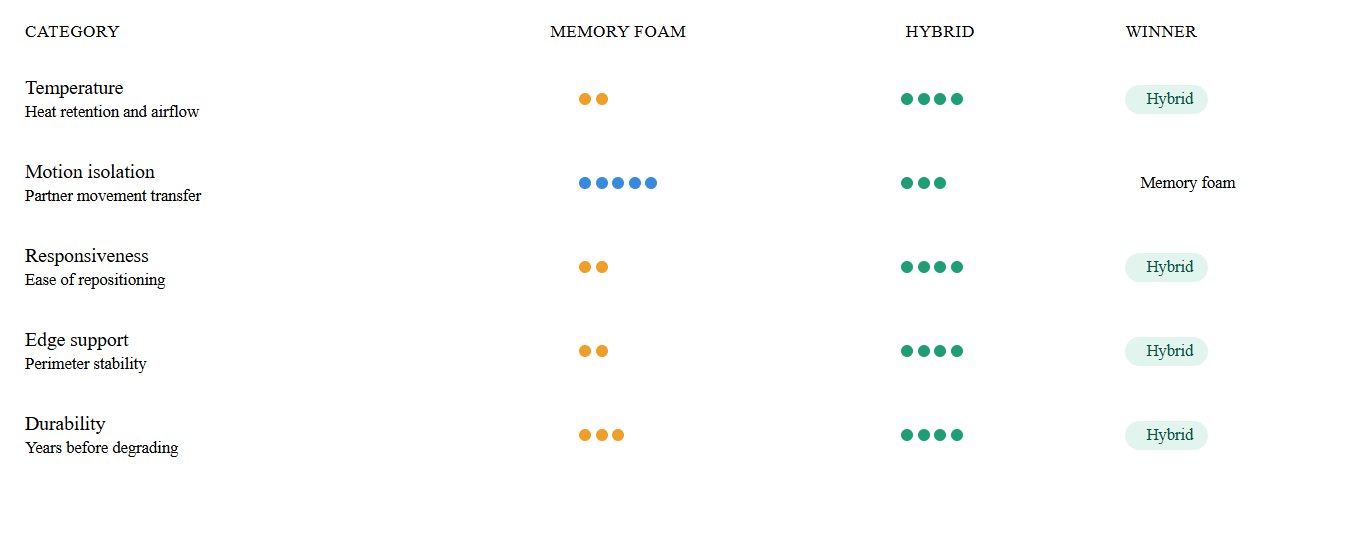
The Five Differences That Actually Matter
1. Temperature
This is the biggest practical difference for most sleepers, and hybrids win clearly.
Memory foam traps heat for two reasons: no internal airflow and high surface contact. The foam contours to your body, which maximises the skin-to-surface contact area. More contact means less convective cooling around your body. The foam also absorbs your body heat and radiates it back.
A pocketed coil core creates vertical air channels running through the mattress. As you move, air circulates through those channels. Heat moves down and out rather than accumulating at the surface.
If you sleep hot, run warm, or have ever woken up sweating on a foam mattress, this is structural, not coincidental. A hybrid with a latex or polyfoam comfort layer solves this almost completely. A memory foam hybrid solves it partially.
Winner: Hybrid (significantly)
2. Motion Isolation
Memory foam wins this category, and it’s not particularly close.
The slow-response nature of memory foam absorbs movement rather than transmitting it. When your partner rolls over, the movement stays on their side. This is why memory foam became the standard recommendation for couples.
Hybrids transmit more motion than all-foam mattresses because the coils can act as conductors. That said, pocketed coils (each coil wrapped individually in fabric) perform much better than older interconnected spring systems. A good pocketed coil hybrid has acceptable motion isolation. It’s just not as good as foam.
If you share a bed with a partner who moves frequently and wakes you up, memory foam has a genuine advantage here.
Winner: Memory foam
3. Responsiveness and Ease of Movement
Memory foam’s slow response — the same property that creates pressure relief — becomes a problem when you try to move.
Getting in and out of bed, changing positions during the night, and repositioning during sex are all noticeably more effortful on memory foam. You sink in, and the foam holds you. For heavier sleepers, this effect is more pronounced.
Hybrids, particularly those with latex comfort layers, are significantly more responsive. You sleep on the mattress rather than in it, and movement requires less effort. For combination sleepers who shift positions regularly, this is a meaningful quality-of-life difference.
Winner: Hybrid
4. Edge Support
Memory foam compresses at the edges the same way it compresses everywhere else. Sitting on the edge of an all-foam mattress creates significant sinkage. This matters if you sit on the edge of the bed regularly, or if you and your partner sleep close to the edges and want to use the full mattress width.
Hybrids reinforce their perimeter with a row of firmer edge coils. The edge holds its shape under pressure. You can sit on the side of the bed without feeling like you’ll slide off, and you can sleep close to the edge without the surface dropping away.
Winner: Hybrid
5. Durability and Longevity
Both materials degrade over time, but at different rates and in different ways.
Memory foam softens with use. High-quality memory foam in a well-made mattress lasts six to eight years before the support properties degrade meaningfully. Lower-quality foam in budget mattresses can soften noticeably within two to three years. The rate depends heavily on the foam density — higher density foam lasts longer.
Hybrids generally outlast all-foam mattresses because the coil support core maintains its structure longer than foam bases. A quality hybrid lasts eight to ten years. The coils outlast the foam comfort layers above them, which is why some hybrids allow comfort layer replacement.
Body weight accelerates degradation in both cases. Heavier sleepers compress foam more aggressively and should prioritise higher-density foams in memory foam mattresses, or choose a hybrid built for heavier weight ranges.
Winner: Hybrid (modestly)
Who Should Choose Memory Foam
Memory foam is the right choice in a specific set of circumstances.
You share a bed and motion transfer is your biggest complaint. If your partner’s movement wakes you up regularly, memory foam solves this more effectively than any hybrid. Nectar Premier Copper and Tuft & Needle Original both perform well for motion isolation.
You are a side sleeper under 160 lbs who does not sleep hot. Lighter side sleepers benefit significantly from memory foam’s deep contouring pressure relief. The heat issue is less severe when you don’t generate much body heat, and the pressure relief at the hip and shoulder is the primary need.
Budget is a genuine constraint. High-quality memory foam starts at $400-$600 for a queen. A quality hybrid in the same price range does not exist. If you’re working with $500 or less, Tuft & Needle Original or Zinus Green Tea Hybrid (a lightweight hybrid, but better than budget foam) are honest options. At $800 and above, hybrids become competitive on value.
You love the contouring, enveloping feel and don’t sleep hot. Some sleepers specifically prefer the feeling of being cradled. If you’ve slept on memory foam before and liked everything except the heat, a memory foam hybrid resolves the problem. If you slept on it and liked it completely, you have no reason to change.
Who Should Choose a Hybrid
For most sleepers, a hybrid is the better overall mattress. This is not a neutral position. It’s based on what the construction actually does.
You sleep hot or even moderately warm. This is the clearest use case. The coil core ventilation addresses the heat problem at a structural level that no foam additive fully replicates. Bear Star Hybrid and GhostBed Flex are the strongest options for hot sleepers.
You are over 160 lbs. Body weight changes how foam behaves. Above 160 lbs, memory foam’s contouring advantage starts to become a sinkage problem. You compress deeper into the comfort layers, the mattress feels softer than its rating suggests, and the support degrades faster. A hybrid’s coil core provides pushback that maintains spinal alignment regardless of weight. Above 200 lbs, this becomes critical rather than advisory.
You are a combination sleeper. Moving between positions on memory foam requires effort. The slow response holds you as you try to reposition. A hybrid with pocketed coils responds quickly to movement and makes repositioning effortless. DreamCloud Hybrid and Helix Midnight are consistently recommended for combination sleepers.
You have lower back pain. The coil support core in a hybrid maintains its support properties longer than foam bases. For back pain specifically, the long-term consistency of support matters as much as the initial feel. WinkBed and Saatva Classic both use hybrid or innerspring constructions specifically for this reason.
You want more than 7-8 years of reliable performance. If you’re buying a mattress you want to use for a decade, a hybrid is the more durable construction at comparable quality levels.
The Body Weight Factor Nobody Covers
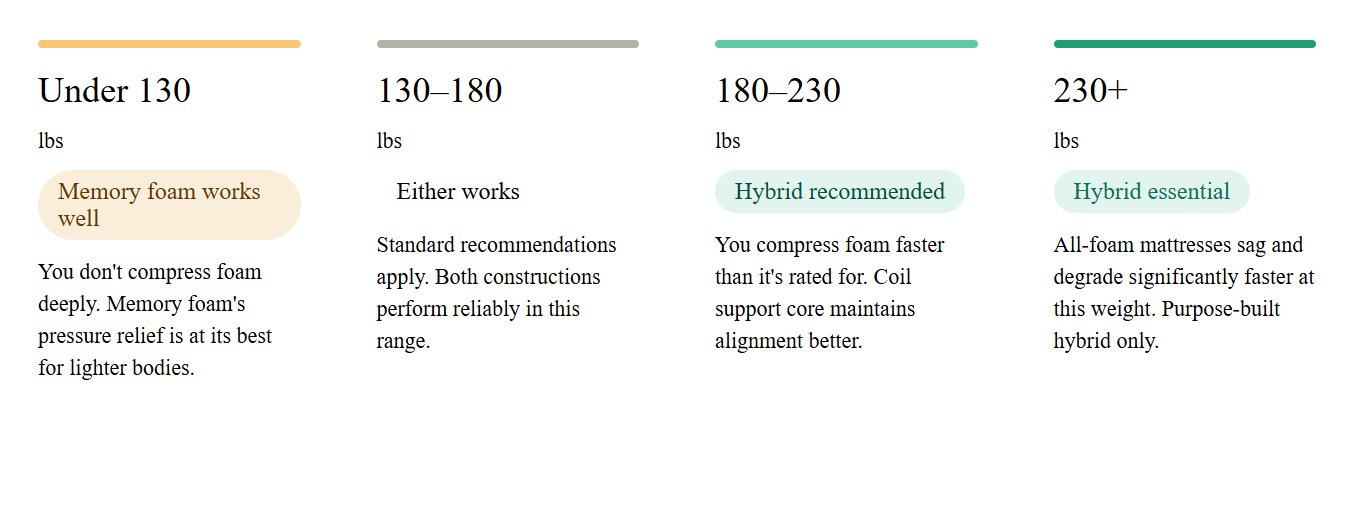
The memory foam vs hybrid comparison changes significantly based on body weight, and almost no guide addresses this directly.
At under 130 lbs, you don’t compress foam deeply. Memory foam’s pressure relief works at its best for lighter bodies. A quality all-foam mattress is a legitimate option.
At 130-180 lbs, both constructions work well. This is the weight range the standard pros and cons lists are calibrated for.
At 180-230 lbs, memory foam starts to compress faster than its rated firmness suggests. The sinkage and heat issues become more pronounced. A hybrid is the stronger recommendation.
Above 230 lbs, an all-foam mattress is a significant risk for both comfort and durability. Foam at higher weights compresses aggressively through the comfort layers, loses its original feel faster, and fails to provide lumbar support. A purpose-built hybrid like Nolah Evolution 15 or WinkBed is the correct construction at this weight range regardless of any other preference.
The Budget Reality
Price comparisons between memory foam and hybrids are frequently misleading because they compare different quality tiers.
A $300 memory foam mattress compared to a $1,200 hybrid is not a useful comparison. Here’s an honest mapping of what each construction costs at comparable quality levels.
Under $500: Memory foam wins by default. No quality hybrid exists at this price point. Zinus and Linenspa make low-cost hybrids, but they’re thin and built for budget constraints, not performance.
$500-$800: Memory foam still has more quality options. Tuft & Needle Original and Nectar original sit in this range and outperform hybrids at the same price.
$800-$1,200: This is where hybrids become competitive and often better value. DreamCloud Hybrid at $649-$899 on sale delivers a construction that no all-foam mattress at the same price can match for cooling and support.
$1,200 and above: Hybrids are generally the better investment. The premium tier of memory foam (Loom & Leaf, Tempur-Pedic) performs well, but quality hybrids at this price (Saatva Classic, WinkBed) offer better longevity and broader compatibility.
Our Honest Recommendation
For most sleepers, buy a hybrid.
The exceptions are clear: if motion isolation is your primary concern, if budget limits you to under $600, or if you specifically prefer the deep contouring foam feel and don’t sleep hot. Those are legitimate reasons to choose memory foam.
For everyone else, the combination of better cooling, easier movement, longer lifespan, better edge support, and more reliable back support makes hybrids the better all-around construction at comparable price points.
If you’re unsure where you fall, our quiz asks about your sleep position, body weight, heat sensitivity, and pain points, then tells you which construction fits your profile.
[Take the free mattress quiz at MattressQuiz.co]
Frequently Asked Questions
Is a hybrid mattress better than memory foam?
For most sleepers, yes. Hybrids sleep cooler, support heavier bodies better, last longer, and are easier to move on. Memory foam wins for motion isolation and deep pressure relief for lighter sleepers. The right choice depends on your specific sleep profile, but hybrid is the better default for the majority of adults.
Does a hybrid mattress feel like memory foam?
A memory foam hybrid has a comfort layer of memory foam over a coil core, so it shares the contouring feel of memory foam while sleeping cooler and providing more support. A latex or polyfoam hybrid feels noticeably different from memory foam. It’s more responsive, bouncier, and has less of the sinking-in sensation. If you’ve loved memory foam and want to switch, a memory foam hybrid is the natural transition.
How long does a hybrid mattress last compared to memory foam?
A quality hybrid lasts eight to ten years. A quality memory foam mattress lasts six to eight years. The coil core in a hybrid maintains its structure longer than foam bases. At higher body weights (180+ lbs), the durability gap widens because heavier compression accelerates foam degradation more than it affects coil structure.
Which is better for back pain: hybrid or memory foam?
Hybrids are generally better for back pain because the coil support core provides consistent lumbar support that maintains its properties over time. Memory foam bases soften with use, which can create progressive lumbar sag that contributes to pain. For side sleepers with upper back and shoulder pain, a memory foam hybrid or latex hybrid with good pressure relief performs well. For lower back pain, a hybrid with a zoned coil system is the most reliable solution.
Which is better for couples?
It depends on what the couple prioritises. For motion isolation (one partner’s movement waking the other), memory foam wins. For couples with different temperature preferences, a hybrid wins on cooling. For couples with different firmness preferences, a hybrid with zoned construction or a latex hybrid with configurable layers is the better choice. Most couples with no specific motion transfer complaint will be happier in a hybrid overall.
Is memory foam or hybrid better for side sleepers?
Both can work for side sleepers. A quality memory foam mattress or memory foam hybrid provides deep contouring at the hip and shoulder, which relieves pressure for side sleepers. A latex hybrid provides good pressure relief with better cooling and responsiveness. For side sleepers who run warm or weigh over 160 lbs, a hybrid is the stronger recommendation. For lighter side sleepers who sleep cool, memory foam’s pressure relief is a genuine advantage.
Affiliate disclosure: Some links in this article are affiliate links. We earn a small commission if you purchase through them at no extra cost to you. It never influences which products we recommend.
Mattress quiz finder
Find the mattress that fits you
Answer a few questions about how you sleep. Get scored matches from our catalog—not a generic roundup.
Start the free quiz