May 10, 2026 · MattressQuiz.co
Mattress Firmness Levels Explained: How to Find the Right One for Your Body
A complete guide to mattress firmness levels, the 1-10 firmness scale, and how to find the right firmness based on your body weight and sleep position. Plus the back pain myth nobody talks about.
You did the research. You slept on your side, so you bought a medium. It still feels wrong.
Here’s the problem. Every firmness guide gives you the same advice: side sleepers need soft to medium, back sleepers need medium-firm, stomach sleepers need firm. That advice is incomplete, and for a significant number of people, it’s actively misleading.
What those guides skip is the other half of the equation: your body weight. A 130-pound side sleeper and a 220-pound side sleeper need completely different mattresses. Recommend the same firmness to both and one of them ends up uncomfortable within a month.
This guide explains how the mattress firmness scale actually works, why firmness and support are not the same thing, how body weight changes what “medium” means in practice, and how to find the firmness that actually fits your body.
The Mattress Firmness Scale: What Each Level Means
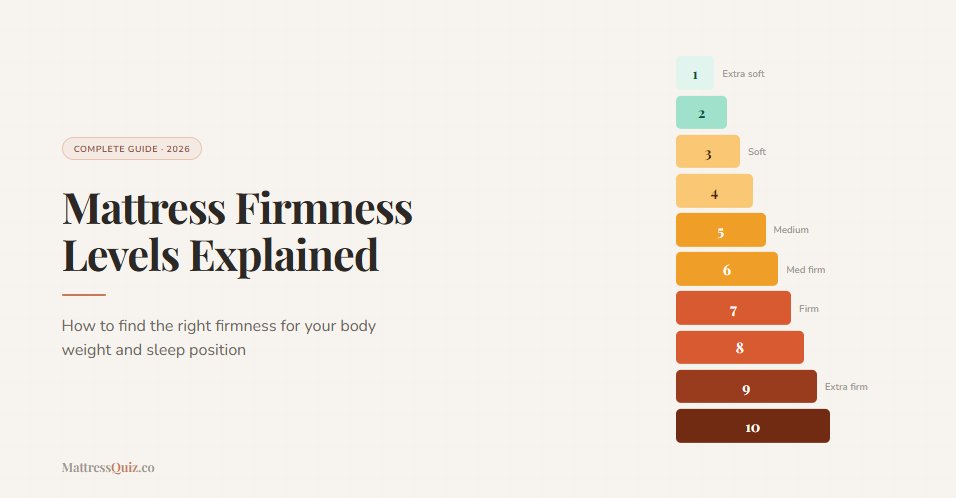
The mattress industry uses a 1 to 10 firmness scale. One is the softest possible surface. Ten is the firmest. In practice, almost nothing sold commercially sits at the extremes. Most mattresses land between 3 and 8.
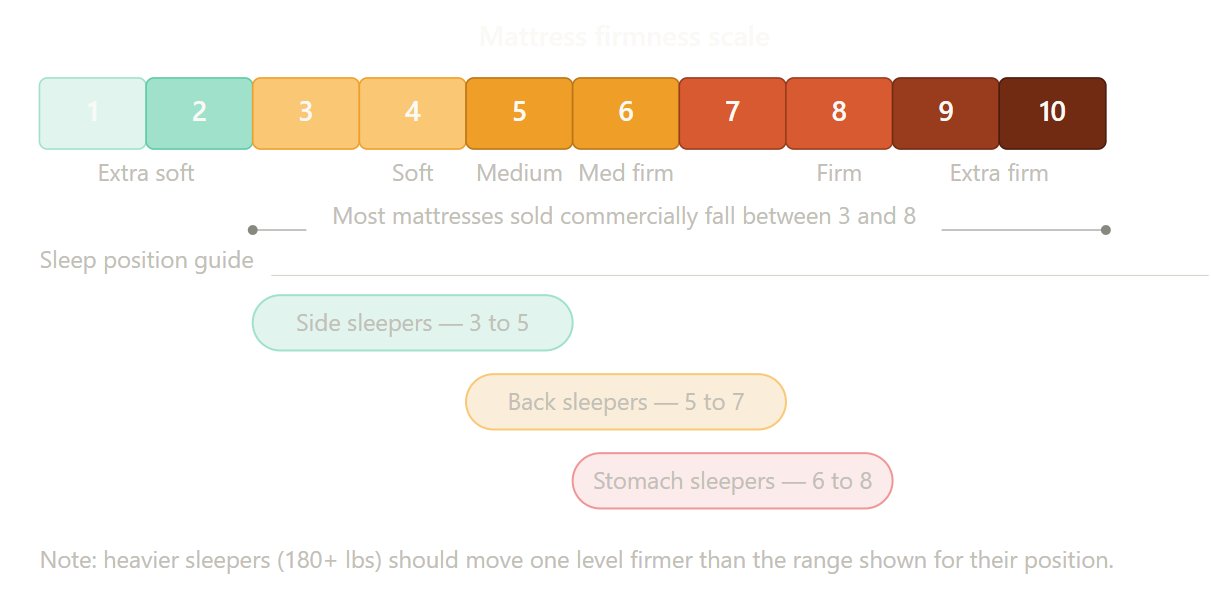
Here is what each level feels like in practice.
Extra Soft (1-2): You sink significantly into the mattress. Strong contouring around every pressure point. Rare in the commercial market. Mostly found in specialty or pillow-top configurations.
Soft (3-4): Noticeable sinkage. Clear pressure relief around hips and shoulders. Good for lightweight side sleepers. Can cause alignment issues for heavier sleepers or back and stomach positions.
Medium (5): The most common firmness sold. Balanced sinkage with enough support to keep most sleepers reasonably aligned. Works well for average-weight side and combo sleepers.
Medium Firm (6): The most recommended firmness across sleep research. Less sinkage than medium, clear pushback, good spinal alignment for most back sleepers. The default recommendation in clinical sleep studies on back pain.
Firm (7-8): Minimal sinkage. You sleep on top of the mattress rather than in it. Required for stomach sleepers and heavier back sleepers. Often mistakenly avoided by people who associate firm with uncomfortable.
Extra Firm (9-10): Very little give. Rare in mainstream retail. Occasionally used for specific medical needs.
One important note: there is no universal standard. A “medium firm” from one brand can feel noticeably different from a “medium firm” from another. The scale is a guide, not a specification.
What About ILD Ratings?
ILD (Indentation Load Deflection) is the technical measurement behind firmness. It measures how many pounds of force it takes to compress a foam sample by 25 percent. A lower ILD means softer foam. A higher ILD means firmer foam.
You will rarely see ILD ratings in mainstream product listings, but premium and latex mattress brands sometimes include them. If you see one, a comfort layer ILD below 20 is soft, 20 to 30 is medium, and above 30 is firm. This is most relevant when comparing latex mattresses.
Firmness vs. Support: The Distinction Nobody Makes
These two words are used interchangeably everywhere. They mean completely different things.
Firmness is what you feel at the surface. It describes the comfort layer. It determines how much you sink in, how much pressure relief you get, and how the mattress feels in the first few seconds of lying down.
Support is what keeps your spine aligned. It comes from the core of the mattress, whether that’s pocketed coils, high-density foam, or a latex base. Support determines whether your spine stays in a neutral position through the night, regardless of how the surface feels.
A mattress can be soft at the surface and have excellent support underneath. A well-built hybrid with a plush comfort layer and strong coil core does exactly this. It relieves pressure at your hips and shoulders while keeping your lumbar spine properly supported.
A mattress can also be firm at the surface and have poor support underneath. Cheap firm foam mattresses often fall into this category. They feel hard, provide no pressure relief, and still fail at spinal alignment because the base is inadequate.
When people say a firm mattress is better for your back, they are usually confusing firmness for support. What actually helps back pain is good support. Sometimes that comes in a firm mattress. Often it doesn’t have to.
Why Body Weight Changes Everything
This is the piece most firmness guides skip entirely, and it’s the reason so many people end up with the wrong mattress.
Firmness is not absolute. It’s relative to your body weight.
A heavier sleeper compresses the comfort layers of a mattress more deeply than a lighter sleeper. On the same medium-firm mattress, a 160-pound person sleeps on top of the comfort layer and feels the pushback of the support core. A 240-pound person compresses through the comfort layer entirely and bottoms out into the support core, making the mattress feel significantly firmer and potentially losing all pressure relief in the process.
This means the standard position-based firmness advice applies most accurately to average-weight sleepers, generally 130 to 180 pounds. If you fall outside that range, adjust accordingly.
Under 130 lbs: You do not compress mattresses deeply. A mattress rated as medium will feel firm to you. Go one to two levels softer than standard position-based recommendations suggest. A side sleeper under 130 lbs should be looking at soft (3-4) rather than medium (5).
130-180 lbs: Standard recommendations apply reasonably well. The position guides in the next section are calibrated for this weight range.
180-240 lbs: You compress comfort layers significantly. A mattress rated medium will feel soft, and a soft mattress will likely cause hip sinkage and alignment problems. Go one level firmer than standard recommendations. A side sleeper in this range should be looking at medium (5-6) rather than soft to medium (4-5).
Over 240 lbs: Standard firmness recommendations are likely to produce a mattress that feels too soft within weeks. Go two levels firmer than standard recommendations and prioritise mattresses purpose-built for higher weight ranges. A side sleeper over 240 lbs needs medium firm (6-7) to maintain alignment.
This weight-adjusted approach to firmness is one of the primary inputs in our mattress quiz, and it consistently produces better-matched results than position alone.
Mattress Firmness by Sleep Position
With the weight adjustment in mind, here is how to match firmness to position. These ranges assume average weight (130-180 lbs). Apply the weight adjustments above if you fall outside that range.
Side Sleepers: Soft to Medium (3-5)
Side sleeping puts significant pressure on the hip and shoulder. The mattress needs to allow those pressure points to sink in enough to keep the spine straight, rather than forcing the spine to curve upward at the hip.
A mattress that is too firm for a side sleeper will hold the hip and shoulder at the surface, creating a lateral curve in the spine that builds into pain over hours of sleep. A mattress that is too soft will let the hip sink too deeply, creating the opposite curve.
The target is enough give to relieve the hip and shoulder without losing spinal alignment.
Back Sleepers: Medium Firm (5-6)
Back sleeping is the most forgiving position for mattress selection. The weight is distributed more evenly, reducing concentrated pressure points.
The risk for back sleepers is lumbar sinkage. If the mattress is too soft, the lower back sinks into a curved position. Medium firm provides the support underneath the lumbar while allowing slight contouring at the shoulders and hips.
Back sleepers with chronic lower back pain should lean toward the firmer end of this range and look for mattresses with zoned lumbar support.
Stomach Sleepers: Firm to Extra Firm (6-8)
Stomach sleeping is the most demanding position in terms of firmness requirements, and the consequences of getting it wrong are the most serious.
When a stomach sleeper sinks into a soft mattress, the pelvis drops below the line of the spine. This hyperextends the lumbar spine and creates a pronounced arch. Over time, this is a reliable cause of chronic lower back pain.
A firm surface keeps the pelvis level with the spine and eliminates the arch. Stomach sleepers should not compromise on firmness, regardless of how the harder surface feels initially. The discomfort of adjustment passes. The back problems from a soft mattress do not.
Combo Sleepers: Medium (5)
Combo sleepers shift between positions through the night, so no single firmness is perfect for every position they spend time in. Medium is the compromise that performs adequately across the range.
Responsiveness matters as much as firmness for combo sleepers. A mattress that allows easy repositioning without fighting the surface is more relevant than chasing the exact right firmness number. Latex hybrids and pocketed coil hybrids perform best here. Memory foam makes repositioning harder.
The Firmness and Back Pain Myth
The most persistent misconception in mattress buying is that firm mattresses are better for back pain.
This became accepted wisdom through decades of medical advice, most of which was based on the assumption that soft mattresses caused sag and misalignment. In many cases, that was true. But the advice got simplified over time into “firmer is better,” which is not what the research actually says.
A study published in The Lancet found that medium-firm mattresses produced significantly better outcomes for chronic lower back pain than firm mattresses. The reason is that medium-firm provides support for spinal alignment while allowing enough contouring to reduce the pressure points that contribute to pain.
An overly firm mattress for a side sleeper, or even a back sleeper with certain body types, creates pressure points at the hip and shoulder that generate pain independently. That pain is often misattributed to the mattress being “too soft,” leading people to go even firmer and making the situation worse.
The correct framework is not “firmer is better for back pain.” It is “adequate support, with enough surface give to prevent pressure pain, for your specific position and weight.” That’s usually medium-firm for back sleepers, and softer for side sleepers even if they have back pain.
How to Find Your Firmness Without Testing in Person
Most mattress purchases today happen without lying on the product first. Here’s how to navigate that.
Use your weight and position as your starting point. The combination of those two variables will get you closer to the right answer than any other input. Use the guidance above, apply the weight adjustment, and start there.
Take the trial period seriously. A one-night test tells you almost nothing. The first few nights on a new mattress are dominated by the novelty of a different surface. Sleep on it for two weeks before making any assessment. If it’s still wrong at two weeks, it’s wrong.
Know what wrong feels like. If you wake up with lower back pain that wasn’t there before, the mattress is either too soft (lumbar sinking) or lacks adequate support in the core. If you wake up with hip or shoulder soreness, the mattress is too firm for your position and weight. Both are clear signals.
Don’t make the mistake of softening a firm mattress. A foam topper on a firm mattress creates a hybrid problem. The topper provides softness but the core remains firm, and the topper adds heat retention. If the mattress is wrong, return it and replace it. The trial period exists for this reason.
Find Your Firmness in Two Minutes
The firmness recommendations above give you a starting range. But the exact right answer also depends on your health conditions, whether you share the bed, your heat sensitivity, and what you’ve tried before.
Our mattress quiz asks about all of this and outputs a specific firmness recommendation, an ideal mattress type, and three matched options from our lineup.
[Take the free quiz at MattressQuiz.co]
Frequently Asked Questions
What firmness mattress do I need for back pain?
Medium firm (6/10) is the most research-supported firmness for back pain, particularly for back sleepers. But position and weight both modify this. A side sleeper with back pain should not go firm. The priority is preventing pressure points at the hip and shoulder while maintaining lumbar support underneath. A soft to medium hybrid with strong coil support does this better than a firm foam mattress.
Is medium firm the same across all mattress brands?
No. There is no universal standard. A medium firm from Saatva will feel different from a medium firm from DreamCloud or Helix. This is one of the reasons trial periods matter. The number is a guideline, not a guarantee.
Can two people with different preferences share the same mattress?
It depends on how different the preferences are. A medium and medium-firm sleeper can often find a compromise. A soft sleeper and a firm sleeper sharing a bed have a genuine conflict. Split firmness options exist, particularly in latex configurations like PlushBeds Botanical Bliss. An adjustable base with dual-zone control is the more expensive but most effective solution.
How does mattress firmness change over time?
Foam softens with use. This is expected and happens with all foam mattresses to varying degrees. A mattress that felt medium firm on day one may feel more like a medium after a year of regular use. Latex is the most durable material and holds its firmness level longest. Memory foam and polyfoam soften the most quickly.
What is the most popular mattress firmness?
Medium (5/10) and medium firm (6/10) account for the majority of mattress sales. Most manufacturers build their default model at 6/10 and treat it as the closest thing to a universal recommendation for average-weight adult sleepers. That default is reasonable for a lot of people, but it fails the ends of the weight distribution in both directions.
Affiliate disclosure: Some links in this article are affiliate links. We earn a small commission if you purchase through them at no extra cost to you. It never influences which products we recommend.
Mattress quiz finder
Find the mattress that fits you
Answer a few questions about how you sleep. Get scored matches from our catalog—not a generic roundup.
Start the free quiz