May 25, 2026 · MattressQuiz.co
How to Choose a Mattress: Everything You Need to Know (2026)
The complete guide to choosing a mattress in 2026. Build your sleep profile, understand mattress types, decode construction specs, and find the right option for your body and budget. No brand sponsorships. No filler.
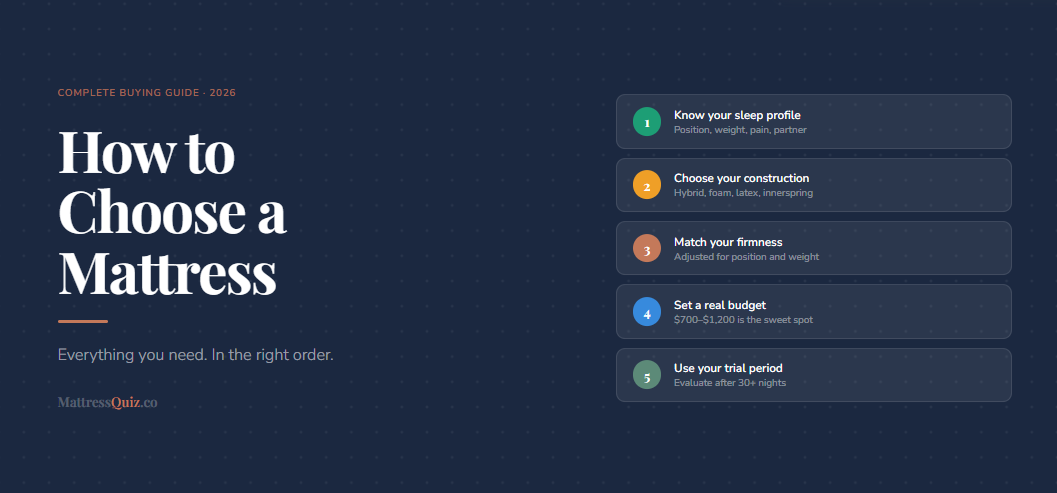
Most people spend more time researching a phone purchase than a mattress. Then they spend the next decade sleeping on the wrong one.
This guide fixes that. It covers everything you actually need to know — in the right order, with real numbers, and with honest opinions about what matters and what doesn’t.
By the time you finish reading, you will know exactly what to buy, why, and what to spend.
Before You Look at a Single Mattress
The mattress industry is confusing by design. Proprietary model names prevent price comparisons. Perpetual “sale” pricing inflates perceived value. Spec sheets are written to obscure rather than clarify. Salespeople are on commission.
The way to cut through all of this is to build your sleep profile before you look at anything. If you know what you need, the purchase decision becomes mechanical. If you don’t know what you need, every brand sounds equally plausible and you end up buying based on marketing.
Your sleep profile has five components. Write them down before reading further.
Part 1: Build Your Sleep Profile
1. Your Primary Sleep Position
This is the position you wake up in most mornings, not the one you fall asleep in. If you genuinely shift between two positions fairly evenly, you are a combination sleeper.
Side sleeping is the most common position and the most demanding for mattress selection. Your weight concentrates on the hip and shoulder. The mattress needs to allow those pressure points to sink enough to keep the spine neutral without allowing the hip to drop below the shoulder line. Side sleepers generally need a softer mattress than any other position.
Back sleeping is the most forgiving position. Weight is distributed more evenly across the surface. The primary risk is lumbar sag when the mattress is too soft, or lumbar gap when it’s too firm. Medium-firm covers most back sleepers well.
Stomach sleeping is the most demanding position for the lower back. The pelvis must be held level with the rest of the spine to prevent lumbar hyperextension. Firm to extra firm is non-negotiable for stomach sleepers regardless of how uncomfortable they expect it to feel. Within a few weeks, the correct firmness produces less pain, not more.
Combination sleeping requires responsiveness above all else. Memory foam is the worst material for combination sleepers because it responds slowly and holds you in position. A responsive hybrid or latex hybrid lets you shift without effort.
→ For deep-dives on each position: [Best Mattress for Side Sleepers], [Best Mattress for Back Sleepers], [Best Mattress for Stomach Sleepers]
2. Your Body Weight
Weight changes how a mattress performs. A 140-pound person and a 240-pound person lying on the same medium-firm mattress have completely different experiences because the heavier person compresses the comfort layers more deeply.
This has two consequences. First, the mattress will feel softer to the heavier person than the firmness label suggests. Second, the mattress will degrade faster for the heavier person because foam and coils are under more sustained pressure.
Under 130 lbs: Lean softer than position-based recommendations suggest. You don’t compress comfort layers deeply, so a medium will feel like a medium-firm to you.
130-180 lbs: Standard recommendations apply. The industry calibrated most of its firmness scales to this range.
180-230 lbs: Go one step firmer than position-based recommendations. Your weight will bring the mattress down to the functional range.
Over 230 lbs: Standard mattresses fail faster at this weight. Prioritise foam density above 1.8 lbs per cubic foot, coil counts above 900 for a queen, and a profile above 12 inches. Purpose-built options are worth the premium.
Over 300 lbs: This is a specialised category. The WinkBed Plus and similar heavy-duty constructions are purpose-built for this range. Standard mattresses, including premium ones, are not appropriate investments at this weight.
→ For a full breakdown: [Best Mattress for Heavy People]
3. Your Biggest Sleep Complaint
Your dominant sleep complaint should drive your decision as much as your position and weight.
You sleep hot: Cooling is the primary variable. All-foam mattresses are the worst choice regardless of any cooling additives they claim. A pocketed coil hybrid with coil airflow is the baseline. For serious heat issues, Bear Star Hybrid (Celliant cover + coil core) and GhostBed Flex (PCM cover + ventilated latex) are purpose-built solutions.
You have lower back pain: Zoned lumbar support matters. WinkBed varies coil gauge by zone. Saatva Classic has Lumbar Zone Quilting built into the cover. Neither feature appears in general-purpose mattresses.
You share a bed with someone who moves a lot: Motion isolation is the primary variable. Memory foam and memory foam hybrids contain movement better than any other construction. Nectar Premier Copper is the strongest motion isolation option in our lineup.
You have shoulder or hip pain from side sleeping: Pressure relief is the primary variable. Helix Midnight is purpose-built for shoulder and hip pressure relief for side sleepers.
You need to get value from a limited budget: Construction quality per dollar is the primary variable. DreamCloud Hybrid at $649-$799 on sale is the strongest construction per dollar in the mid-range.
→ Specific guides: [Best Mattress for Hot Sleepers], [Best Mattress for Back Pain], [Best Mattress for Couples]
4. Your Budget
Be honest about this number before you look at anything. The mattress industry is particularly effective at stretching budgets because the stakes feel high and the price anchors are manipulated.
We will cover honest price tiers in Part 5. The short version: for a primary mattress you sleep on every night, $700-$1,200 is where real quality lives. Below $500, you are in compromise territory. Above $1,500, you are mostly paying for brand positioning and delivery service rather than sleep quality.
5. Whether You Share the Bed
If you share a bed, your partner’s sleep profile matters as much as yours — and if they conflict, you have a specific problem to solve. The four couples problems (motion transfer, temperature mismatch, firmness conflict, weight disparity) each have different solutions.
→ Full breakdown: [Best Mattress for Couples]
Part 2: Mattress Types — What Each One Actually Does
Memory Foam
Memory foam is viscoelastic polyurethane foam that softens with body heat and moulds to your shape. It is the best material on the market for pressure relief and motion isolation. It is among the worst for temperature regulation and responsiveness.
When to choose it: You sleep primarily on your side, you share a bed with a restless partner, and you don’t sleep hot.
When to avoid it: You’re a combination sleeper (slow response makes repositioning effortful), you sleep hot (foam traps heat), or you’re over 180 lbs (foam compresses and degrades faster at higher weights).
The quality spec that matters: Foam density. High-quality memory foam is 3.0 lbs per cubic foot or above in the comfort layer. Budget memory foam is 1.2-1.5 lbs per cubic foot. The difference is not visible but determines whether the mattress lasts 3 years or 8 years under regular use. Brands almost never advertise this number.
Hybrid
A hybrid combines a pocketed coil support core with foam or latex comfort layers. When built well, hybrids are the most versatile mattresses available. When built cheaply, they are an inferior version of both.
A quality hybrid gives you coil airflow (better temperature regulation than all-foam), coil responsiveness (easier repositioning than all-foam), and still delivers meaningful pressure relief through the comfort layer. It also lasts longer than an all-foam mattress because the coil support core degrades more slowly than a foam base.
The most important quality variable: coil count and gauge. A queen hybrid with 800+ individually pocketed coils and a 14-15 gauge wire has meaningfully better support distribution than one with 400 coils and 16-gauge wire. The difference appears over time as the lower-spec system compresses under repeated use.
When to choose it: Most people. Hybrids are the right default for the majority of sleepers.
When all-foam beats hybrid: You share a bed with a partner who wakes you up and you don’t sleep hot. All-foam motion isolation is better than any hybrid.
→ Full comparison: [Hybrid vs Memory Foam Mattress]
Latex
Natural latex comes from rubber trees and has properties that no synthetic material exactly replicates: it is pressure-relieving, responsive, naturally cool, and durable enough to last 15-20 years with proper care.
Dunlop latex (dense, heavier, more supportive) suits back and stomach sleepers. Talalay latex (lighter, more consistent cell structure, slightly softer) suits side sleepers better.
Natural latex is certified under GOLS (Global Organic Latex Standard). Synthetic latex and blended latex are sold at lower price points but do not deliver the same durability or the same cooling properties. If latex is your reason for buying, ask for the GOLS certification.
When to choose it: You want the most durable construction available, you sleep hot and want natural cooling, you prefer a responsive feel with genuine pressure relief, or you’re buying organic for health or environmental reasons.
Watch out for: “Latex” listed as an ingredient in a foam blend. This is marketing, not latex construction.
Innerspring
A traditional innerspring mattress uses coils as both the support and comfort system. Modern innersprings use individually pocketed coils that reduce motion transfer and improve support consistency. Older interconnected coil systems transmit movement across the entire surface and fail faster.
Innersprings sleep cooler than any foam construction because there’s nothing blocking airflow. They’re more durable than foam-only mattresses. The limitation is pressure relief — a thin foam or fibre pillow top is the only comfort layer, which is insufficient for side sleepers with significant pressure points.
When to choose it: You’re a back or stomach sleeper who sleeps hot and wants a traditional feel. Saatva Classic’s dual coil system is the standout example.
Airbed
Adjustable air bladder systems, most notably Sleep Number, allow each partner to set an independent firmness level. They’re useful for couples with genuinely incompatible firmness needs and for people whose firmness requirements change over time.
The limitation: mechanical complexity means mechanical failure is possible. The foam layers surrounding the bladder still age and degrade. Service requirements exist. They are a legitimate solution to a specific problem, not a default recommendation.
Part 3: Firmness — The Number That Changes Based on Your Body
The 1-10 firmness scale is not standardised across manufacturers. One brand’s 6 is another brand’s 5. The scale is a guide, not a precise measurement. Always read trial policies with this in mind.
What Each Level Means
1-2 (Extra Soft): Rarely sold commercially. Significant sinkage, deep contouring. Best for very lightweight side sleepers with significant pressure issues.
3-4 (Soft): Deep contouring, clear sinkage. Side sleepers under 130 lbs, anyone with significant hip or shoulder pressure pain.
5 (Medium): The industry default. Balanced sinkage, suitable for average-weight combination and side sleepers.
6 (Medium Firm): The most evidence-supported firmness level for back pain, back sleeping, and most average-weight profiles. Where most quality mid-range mattresses sit.
7-8 (Firm): Minimal sinkage. Required for stomach sleepers and heavier back sleepers. Often miscategorised as uncomfortable — for the right profile it is significantly more comfortable than softer options.
9-10 (Extra Firm): Very rare commercially. Occasionally purpose-built for very heavy sleepers or specific medical requirements.
The Weight Adjustment Rule
For every sleep position, heavier weight requires firmer than the standard recommendation. This is because heavier bodies compress comfort layers more deeply, bringing the functional firmness down from the rated level.
A side sleeper at 150 lbs should start at medium (5). The same side sleeper at 220 lbs should start at medium-firm (6), because their weight will bring the mattress down to an effective medium-soft range.
Firmness vs Support
These are different things and they are confused constantly.
Firmness is what you feel at the surface. It comes from the comfort layer.
Support is what keeps your spine aligned. It comes from the coil core or support foam underneath the comfort layer.
You can have a soft surface with excellent spinal support if the support core is good. You can have a firm surface with poor spinal support if the core is inadequate. Budget mattresses often have a firm surface to simulate support without a functional support core underneath. They feel supportive on day one and progressive alignment problems develop over months.
The firmness number tells you about the surface. The coil gauge and foam density tell you about the support. Both matter.
→ Deep dive: [Mattress Firmness Levels Explained]
Part 4: Construction Quality — The Specs Nobody Talks About
These are the numbers that separate a mattress that lasts 8 years from one that lasts 3, and they are almost never prominently displayed in product listings.
Foam Density
Measured in lbs per cubic foot (lb/ft³). Higher density foam resists compression and maintains its original feel longer.
Comfort layer foam:
- Below 1.5 lb/ft³: Budget construction. Will compress noticeably within 2-4 years under regular use.
- 1.5-2.0 lb/ft³: Mid-range quality. 5-7 years of reliable performance.
- 2.0-3.0 lb/ft³: Premium quality. 8-10+ years. Used in purpose-built heavy-duty and luxury mattresses.
- For memory foam specifically: look for 3.0 lb/ft³ or above in the comfort layer.
How to find this number: It is often in the product specifications tab rather than the main description. If it’s not listed at all, that is itself a meaningful signal — brands using high-density foam advertise it. Brands using budget foam don’t.
Coil Count and Gauge
For hybrids and innersprings, coil count and gauge are the primary structural quality indicators.
Coil count (queen size):
- Below 600: Entry-level. Wider spacing means less consistent support.
- 600-900: Mid-range. Adequate for average-weight use.
- 900+: Premium. Finer-grained support, better motion isolation, longer-lasting structure.
Coil gauge: This is wire thickness. The scale runs backward — lower gauge numbers mean thicker, stronger wire.
- 16-17 gauge: Standard consumer grade.
- 14-15 gauge: Premium. More resistant to fatigue under regular and heavier use.
- 12-13 gauge: Purpose-built heavy-duty mattresses (WinkBed Plus, etc.)
Profile Height
Taller mattresses can accommodate thicker comfort layers above deeper support cores without sacrificing either. For heavier sleepers in particular, 12-15 inch profiles are meaningfully better than 10-inch ones.
- 8-10 inches: Budget and entry-level. Thin comfort layers or shallow support core or both.
- 10-12 inches: Standard mid-range. Adequate for average-weight sleepers.
- 12-15 inches: Premium. Allows full-depth comfort and support layers. Nolah Evolution 15 at 15 inches is purpose-built.
Cover Materials
Quilted polyester: Standard. Does the job. No meaningful cooling contribution. Tencel/lyocell: Moisture-wicking, breathable. A genuine upgrade for warm sleepers. Organic cotton: Natural, breathable, comfort upgrade. Look for GOTS certification. Wool: Temperature regulating year-round. Naturally cooling in summer, warming in winter. Phase-change material (PCM): Absorbs heat at the surface level. GhostBed Flex and Brooklyn Bedding (post-January 2026) use this effectively. Celliant: Converts body heat to infrared energy. Bear uses this. Clinical backing exists.
Part 5: What You Actually Get at Each Price Point
These are honest tier descriptions with named brand examples. All prices are approximate queen sizes at typical sale pricing.
Under $400 — Guest Rooms and Temporary Use
Zinus Green Tea Hybrid ($250-$350), Linenspa 8-Inch ($150-$200), Lucid 10-Inch ($250-$299)
You are in compromise territory. Foam density is 1.2-1.5 lb/ft³. Coil systems have 400-600 coils. Trials are 30-100 nights. Expected lifespan is 2-4 years under regular use.
These mattresses are entirely appropriate for guest rooms, children’s rooms, and temporary use. They are not suitable investments for a primary bed you sleep on every night.
$400-$700 — The Entry Point to Real Quality
Allswell Hybrid ($299-$395), Tuft & Needle Original ($595-$695), lower-end DreamCloud on sale ($649)
This is where the market meaningfully improves. Foam density crosses the 1.5 lb/ft³ threshold. Some brands (T&N, Allswell) have honest reputations for quality at this price. Trials extend to 100 nights. Warranties become serious.
The DreamCloud Hybrid on deep sale sits at the top of this tier and genuinely punches into the next category on construction quality.
$700-$1,200 — The Sweet Spot
DreamCloud Hybrid ($649-$999 on sale), Helix Midnight ($899-$1,099), Nectar Premier Copper ($799-$999), Bear Star Hybrid ($849-$1,099), Tuft & Needle Mint Hybrid ($895), Leesa Original Hybrid ($749-$999), GhostBed Flex ($995-$1,145), Cocoon by Sealy Chill ($749-$999), Brooklyn Bedding Signature ($999-$1,099)
This is where the mattress market produces its best value. Foam density is 1.8-2.0 lb/ft³. Coil counts cross 800. Trials are 100-365 nights. Warranties are 10 years to lifetime. Expected lifespan is 7-10 years under regular use.
Most people buying a primary mattress for everyday use should be in this range. The quality improvements above this tier exist but are incremental for the price increase.
→ Full breakdown: [Best Mattress Under $1,000]
$1,200-$2,000 — Purpose-Built and Premium
WinkBed ($1,499-$1,799), Saatva Classic ($1,595-$1,795), Nolah Evolution 15 ($1,099-$1,299), Casper Wave Hybrid ($2,295), Avocado Green Mattress ($2,039-$2,399), PlushBeds Botanical Bliss ($1,949+)
This tier includes mattresses purpose-built for specific profiles: zoned lumbar support for back pain, heavy-duty coil construction for heavier sleepers, organic certification for health and environmental buyers, and white-glove delivery for those who value full service.
The premium over the $700-$1,200 tier is justified for specific needs. It is not justified for general-purpose sleeping where a quality mid-range hybrid performs equivalently.
$2,000+ — Luxury and Specialist
Purple RestorePlus ($2,499-$2,999), Tempur-Pedic TEMPUR-breeze ($3,299-$3,799), Stearns & Foster ($1,799-$2,499)
At this tier you are paying for either best-in-class performance on a specific dimension (Purple for cooling, Tempur-Pedic for pressure feel and brand) or luxury materials and brand positioning.
Note on Tempur-Pedic specifically: the brand commands premium pricing on heritage and performance. The cooling variants (breeze line) have significantly improved but all-foam construction still limits their performance for hot sleepers. Do not recommend to hot sleepers regardless of budget.
Part 6: The Sale Price Reality
Most mattress brands operate on a perpetual discount model. The listed regular price is a reference number designed to make the sale price look impressive. Almost nobody pays regular price.
How the pricing actually works: A brand lists a queen at $1,499 regular price. The mattress sells at $699-$899 essentially every day, with occasional deeper sales bringing it to $599-$649. The “50% off sale” you see is not a temporary event — it is the standard operating pricing model.
The practical implication: Never pay the listed regular price for a mid-range or premium mattress.
How to get the best price:
- Sign up for the brand’s email list. DreamCloud, Nectar, Bear, Helix, and Saatva all send discount codes within 24-48 hours of signup.
- Time major purchases around sale events. Memorial Day (May), Labor Day (September), Black Friday (November), and Presidents’ Day (February) consistently produce the deepest discounts of the year — typically 25-40% below standard sale pricing.
- Check for bundled deals. Many brands include free pillows, protectors, or sheet sets during sale events. The value of these accessories at retail is real.
The one exception: Saatva’s pricing is more stable than most brands and does not fluctuate as dramatically. Their sale events produce smaller but genuine discounts.
Part 7: The Sleep Trial Strategy
A 100-365 night sleep trial is the most consumer-friendly policy in the mattress industry. Use it properly.
The Break-In Period
Most mattresses require 3-6 weeks before you can accurately evaluate them. The foam needs to soften slightly from its manufactured state, and your body needs to adjust from your previous sleep surface. If a mattress feels wrong in week one, do not return it yet.
The right time to evaluate: night 30 to night 60. You have had enough time to adjust. You still have most of the trial remaining if you need to return.
What You Are Evaluating
Morning back or neck pain that was not there before: The mattress is wrong for your position and weight. This signal is reliable.
Hip or shoulder pain on the side you sleep on: The mattress is too firm for your position. This signal is reliable.
Waking up hot: The mattress is contributing to heat retention. This signal is reliable for mid-trial assessment.
Just feels different from your old mattress: This is not a signal. Different is not wrong. Give it more time.
What to Do If It’s Wrong
Most brands allow free exchanges to a different firmness option before you initiate a return. This is worth doing before returning entirely. Firmness miscalculation is the most common reason mattresses feel wrong, and changing from medium to medium-firm (or vice versa) often resolves the issue.
Part 8: Warranties, Foundations, and What Actually Protects You
What Warranties Cover
Most mattress warranties cover two things: manufacturing defects and excessive sagging defined as body impressions exceeding a threshold. That threshold is typically 1 to 1.5 inches for mid-range brands and as low as 0.75 inches for premium brands.
What warranties do not cover: normal wear, comfort preference changes, or anything caused by an improper foundation. This last point causes more warranty claim denials than anything else.
Foundation Requirements
Using the wrong foundation voids most mattress warranties. The correct foundation depends on the mattress type.
For foam and hybrid mattresses: A solid platform with slats no more than 3 inches apart, a platform bed with solid or slatted support, or a box spring rated for foam mattresses. Old-style box springs with open coil construction and significant flex are not adequate and are one of the most common warranty voiding causes.
For innerspring mattresses: Traditional box springs are appropriate. Platform beds also work.
Adjustable bases: Most modern hybrids and foam mattresses are compatible with adjustable bases. Check manufacturer specifications before buying.
The law tag rule: Leave the law tag attached. Removing it is listed as a warranty-voiding action by virtually every manufacturer.
What Actually Protects You Beyond the Warranty
The real consumer protection comes from trial periods, not warranties. A 365-night trial is a far stronger guarantee than a 10-year warranty, because trial periods cover “this doesn’t work for me” while warranties only cover “this is physically defective.”
Brands with long trials (DreamCloud at 365 nights, Saatva at 365 nights, Nectar at 365 nights, Avocado at 365 nights) are making a confidence statement about their product. This correlation matters.
Part 9: Red Flags and Industry Tricks
“Worth $2,000, on sale today for $899.” The regular price is not a real price. Do not use it as an anchor.
Proprietary model names. Mattress stores use unique model names for standard mattresses to prevent price comparison between retailers. The same base mattress sold as “Hotel Grand” in one store may be sold as “Luxury Sleep Edition” in another at a very different price. If you’re buying in-store, ask for the manufacturer SKU or model number.
Coil count marketing. “1,000 coils!” sounds impressive but means nothing without knowing the gauge and whether they’re pocketed or interconnected. A 1,000-coil mattress with 17-gauge interconnected coils is less supportive than an 800-coil mattress with 14-gauge pocketed coils.
Cooling claims on foam mattresses. Gel infusion, copper infusion, graphite infusion — all improve on standard foam modestly. None of them make an all-foam mattress comparable to a hybrid for temperature regulation. The coil core is what creates airflow.
“Orthopedic” and “chiropractic approved” labelling. These terms have no regulated standard. They are marketing phrases. Some chiropractic associations take payments from mattress brands for endorsement rights. The American Chiropractic Association endorsement that Saatva Classic holds is based on a paid commercial relationship, not independent clinical testing.
Comfort layer thickness claims. A “3-inch memory foam” mattress could mean 3 inches of a single foam layer or 3 inches total across three thin layers. The construction quality and density of each layer matters more than the total depth.
Part 10: The Decision Framework
If you’ve read this far, here is the practical decision process.
Step 1: Identify your primary need
Hot sleeper? Go to hybrid with cooling construction first. [Best Mattress for Hot Sleepers]
Back pain? Go to zoned hybrid first. [Best Mattress for Back Pain]
Side sleeper with pressure issues? Go to purpose-built side sleeper hybrid. [Best Mattress for Side Sleepers]
Heavier build (180+ lbs)? Go to purpose-built construction first. [Best Mattress for Heavy People]
No specific need? Default to a quality mid-range hybrid.
Step 2: Apply your weight and position to firmness
Use the weight adjustments in Part 1. Your starting firmness is position-based, adjusted up by one step for every 50 lbs above 180 lbs.
Step 3: Set a real budget
Decide your number before looking at prices. The industry is effective at expanding budgets once you’re engaged with a product.
Step 4: Use the quiz
Our mattress quiz takes your sleep profile — position, weight, heat sensitivity, pain history, and budget — and narrows the field to three matched options in about two minutes. It factors in all the weight adjustments and specific-need routing described in this guide.
[Take the free mattress quiz at MattressQuiz.co]
Step 5: Buy with the longest trial available
Everything else being equal, the longest trial is the strongest safety net. Use the full trial strategically as described in Part 7.
Our Full Guide Library
Every major sleep topic has a dedicated, in-depth guide on this site:
By sleep position:
- [Best Mattress for Side Sleepers]
- [Best Mattress for Back Sleepers]
- [Best Mattress for Stomach Sleepers]
By sleep problem:
- [Best Mattress for Hot Sleepers]
- [Best Mattress for Back Pain]
- [Best Mattress for Couples]
- [Best Mattress for Heavy People]
By budget:
- [Best Mattress Under $1,000]
Educational:
- [Mattress Firmness Levels Explained]
- [Hybrid vs Memory Foam: Which Is Better for You?]
Frequently Asked Questions
How long should a mattress last?
A quality mattress at the $700-$1,500 tier should last 7-10 years under regular use at average body weights. Below $500, expect 2-4 years. Natural latex mattresses can last 15-20 years. Higher body weight accelerates degradation for foam-based mattresses. Signs you need a new mattress: visible sagging or body impressions, waking with pain that was not there a year ago, or mattress age beyond 8-10 years.
Should I buy a mattress in-store or online?
Both are legitimate. In-store gives you the ability to test feel before buying, which has genuine value. The limitations are aggressive commission-based selling and pricing that is harder to compare. Online gives you competitive pricing, genuine trial periods (usually 100-365 nights), and the ability to research independently. The trial period for online purchases effectively functions as a longer, more realistic test than 10 minutes on a showroom floor.
What mattress size should I buy?
For a single adult: queen. It gives you more room than a full at a modest price premium, and fits most bedrooms. For a couple: queen if the bedroom is small, king if you can accommodate it. A king gives each partner 8 more inches of width than a queen, which meaningfully reduces motion transfer and is worth the additional cost if space allows. California king adds length (84 inches vs 80) for tall sleepers but reduces width compared to a standard king.
Is a firmer mattress better for your back?
Not generally. Research published in The Lancet found that medium-firm produced significantly better outcomes for chronic lower back pain than firm over a 90-day trial. The correct framing is not firmer vs softer but appropriate support vs inappropriate support. For most back sleepers, medium-firm (6/10) provides optimal results. For stomach sleepers, firm to extra firm is correct. For side sleepers, softer is usually better than firmer.
How do I know if my current mattress needs replacing?
Four reliable indicators: visible body impressions or sagging beyond 0.75-1 inch; waking up with pain (particularly lower back or hip pain) that improves within 30-60 minutes of getting up; waking up from sleep feeling unrefreshed consistently; or mattress age beyond 8-10 years for foam/hybrid, beyond 5-7 years for budget foam, beyond 15-20 years for natural latex.
What is the best mattress brand in 2026?
Depends on what you need. For overall construction quality and service: Saatva. For side sleepers at mid-range price: Helix. For hot sleepers: Bear. For heavy sleepers: WinkBed (Plus option). For organic construction: Avocado. For best value overall: DreamCloud on sale. There is no universal best mattress because the best option depends on body type, sleep position, and primary concern.
Do I need a box spring?
Modern mattresses generally do not require a traditional box spring, and traditional open-coil box springs can actively damage foam-based mattresses by providing insufficient support. What you need is a flat, solid surface: a platform bed, a slatted foundation with slats no more than 3 inches apart, or a mattress foundation. Always check the manufacturer’s foundation requirements — using the wrong foundation voids most warranties.
Affiliate disclosure: Some links in this article are affiliate links. We earn a small commission if you purchase through them at no extra cost to you. It never influences which products we recommend.
Mattress quiz finder
Find the mattress that fits you
Answer a few questions about how you sleep. Get scored matches from our catalog—not a generic roundup.
Start the free quiz