May 25, 2026 · MattressQuiz.co
Tempur-Pedic vs Sleep Number: Two Luxury Brands, Two Completely Different Products (2026)
Tempur-Pedic and Sleep Number are not competing for the same customer. Here's the honest breakdown of what each brand actually does, who each one is built for, and when you should skip both entirely.
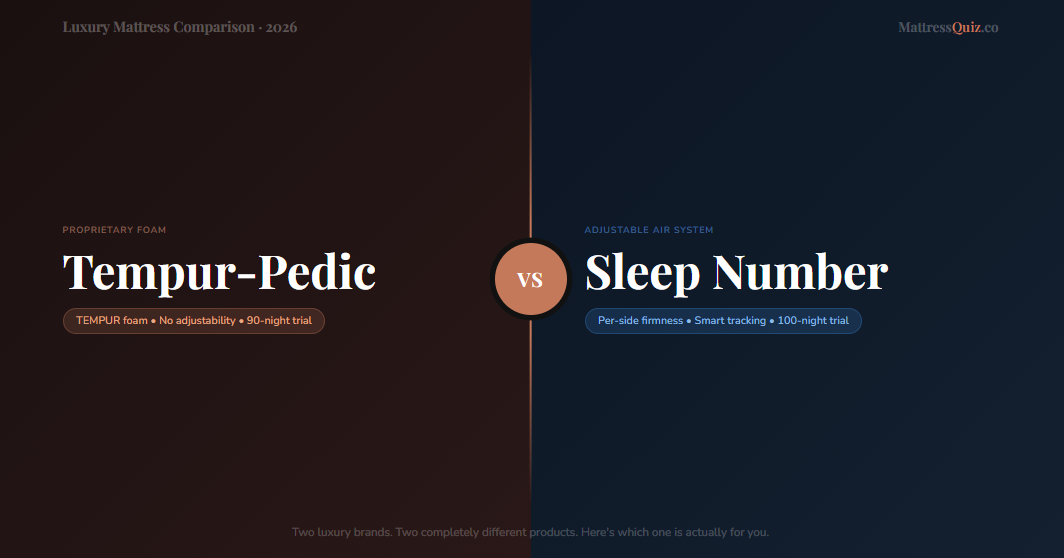
Choosing between Tempur-Pedic and Sleep Number is less like choosing between two mattresses and more like choosing between a sports car and an SUV. Both are expensive.
Both are well-made. But they solve different problems for different drivers, and choosing the wrong one for your use case produces an expensive mistake.
Most comparison guides treat this as a straightforward head-to-head. It isn’t. Tempur-Pedic is a premium foam mattress brand built around a proprietary material that has genuine performance properties.
Sleep Number is an adjustable air chamber system with smart technology built around the concept of customisable firmness. These are different categories of product with different strengths, different failure modes, and different ideal buyers.
The right question is not which is better. It is which problem you are actually trying to solve.
What Tempur-Pedic Actually Is
Tempur-Pedic makes mattresses using TEMPUR material, a proprietary viscoelastic foam developed from a NASA pressure-absorbing technology in the 1970s. The company acquired the material in the 1990s and built one of the most recognised luxury mattress brands in the world around it.
TEMPUR foam is denser and more precisely responsive to pressure and temperature than standard memory foam. It contours more closely to the body’s exact shape, provides more consistent pressure relief across different sleep positions, and returns to its original form more slowly than generic memory foam. The material is not identical to off-the-shelf memory foam regardless of what budget alternatives claim.
The Tempur-Pedic lineup in 2026:
Cloud line (~$2,199+ queen): Entry-level Tempur-Pedic. All-foam, no cooling technology. Appropriate for buyers who want the TEMPUR feel at the lowest available price point. Sleeps warmly.
Adapt line (~$2,799-$3,399 queen): Mid-range. Available in hybrid (with pocketed coils) or all-foam. The hybrid version addresses the heat retention problem more effectively than the all-foam. The most balanced Tempur-Pedic option for most buyers.
TEMPUR-breeze line (~$3,299-$3,799 queen): Cooling-focused all-foam. Phase-change material cover and ventilation channels address heat retention. This is the Tempur-Pedic model in our affiliate lineup. Significant improvement over standard TEMPUR foam for warm sleepers, though still a foam-based product.
LuxeBreeze and ProBreeze (~$4,199-$7,699 queen): The premium cooling range. Genuine improvement on temperature management for hot sleepers willing to spend at this level. Still foam. Still not as effective for hot sleepers as a purpose-built hybrid like Bear Star Hybrid or GhostBed Flex at a fraction of the price.
What Tempur-Pedic does well: Pressure relief that is legitimately superior to generic foam. Brand heritage and recognition. Consistent quality across the lineup. Wide availability — including retail stores for in-person testing.
What Tempur-Pedic does poorly: Heat retention is the brand’s persistent weakness. No Tempur-Pedic mattress sleeps as cool as a quality pocketed coil hybrid regardless of the cooling technology applied to it. Foam-first construction is fundamentally limited in airflow compared to coil-based systems.
What Sleep Number Actually Is
Sleep Number is not a mattress in the traditional sense. It is an adjustable air chamber system with foam comfort layers on top.
The core of every Sleep Number bed is one or two air bladders (one per side in dual-chamber models) that inflate or deflate on demand. Each partner can set their “Sleep Number” — a firmness setting from 0 to 100 — independently using a remote or smartphone app. When you change your number, the chamber inflates or deflates to match.
The smart bed models add biometric tracking. The p-Series and i-Series 360 Smart Beds use sensors to track breathing rate, heart rate, and movement throughout the night and adjust firmness automatically in response to detected conditions (snoring, restlessness). The Climate360 models add active temperature control using air channels and heating/cooling elements.
The Sleep Number lineup in 2026:
Classic Series (c2, c4): Entry-level adjustable. One or two air chambers, basic foam comfort layers, no smart technology. Queen pricing from approximately $1,099 (c2) to $1,799 (c4).
Performance Series (p5, p6): Mid-range. Dual air chambers with smart adjustment. Zoned support. Queen from approximately $2,299.
Innovation Series (i7, i8, i10): Premium. Advanced smart technology, better foam comfort layers, deeper zoning. Queen from approximately $3,099.
Climate360: Active temperature control on both sides independently. Dual air chambers plus thermal management. Approximately $4,999+ queen.
What Sleep Number does well: Independent per-side firmness is the most effective solution for couples with genuinely incompatible firmness needs. Long-term adjustability means the mattress can adapt as your needs change. Smart sleep tracking provides genuine sleep data. The active temperature control in Climate360 models is a real solution for the problem of temperature mismatch between partners.
What Sleep Number does poorly: Mechanical complexity means mechanical failure. Air bladder leaks, pump malfunctions, controller failures, and connectivity issues are documented Sleep Number failure modes that do not exist in a passive foam or hybrid mattress. Long-term ownership includes maintenance costs and parts replacement that traditional mattresses do not. The foam comfort layers still age and degrade the same way any foam does.
Head-to-Head: The Factors That Actually Matter
Pressure Relief
Advantage: Tempur-Pedic. TEMPUR foam’s dense, slow-response contouring provides superior pressure relief to Sleep Number’s foam comfort layers. For side sleepers with significant shoulder or hip pressure, or anyone with pain conditions requiring consistent pressure distribution, Tempur-Pedic performs better.
Couples with Different Firmness Needs
Advantage: Sleep Number. This is Sleep Number’s defining use case and where no passive mattress competes. If you need Medium-Firm and your partner needs Soft, and that difference is non-negotiable, Sleep Number’s dual air chambers are the most practical long-term solution. Tempur-Pedic offers no adjustability. PlushBeds Botanical Bliss offers per-side firmness customisation in latex, but the range is more limited and less precise than Sleep Number’s 0-100 scale.
Temperature Regulation
Advantage: Varies. Standard Tempur-Pedic sleeps warm — among the warmest constructions on the market. The breeze line and ProBreeze improve meaningfully on this. Sleep Number’s basic models sleep similarly warm. The Climate360 line with active thermal management is the most effective passive-plus-active temperature solution of either brand, but at approximately $5,000+ it is a significant investment.
For hot sleepers who do not need the specific features either brand offers, a pocketed coil hybrid (Bear Star Hybrid, GhostBed Flex) solves the problem at $800-$1,100 more effectively than either Tempur-Pedic or Sleep Number standard models.
Long-Term Reliability
Advantage: Tempur-Pedic. A Tempur-Pedic mattress is a passive product with no moving parts, no electronics, no air chambers, and no pump. It degrades over time the way all foam degrades, but it has no mechanical failure modes. Sleep Number mattresses have documented mechanical failure modes: air pump failures, bladder leaks, and controller malfunctions. These are not common but they exist, and when they occur, repair requires proprietary parts. The foam layers in Sleep Number mattresses also degrade independently of the air system.
Smart Features and Sleep Tracking
Advantage: Sleep Number. Tempur-Pedic offers no smart features in its standard lineup. Sleep Number’s 360 Smart Beds track biometric data (heart rate, breathing, movement) and provide meaningful sleep quality information through the SleepIQ app. For buyers who want quantified sleep data or automatic firmness adjustment, Sleep Number is the only option of the two.
Availability and Testing
Advantage: Tempur-Pedic. Tempur-Pedic is widely available at retail stores including Mattress Firm, Sleepy’s, and department stores. You can test the feel before buying. Sleep Number has standalone Sleep Number stores in most US metro areas, but the availability is more limited.
When to Choose Tempur-Pedic
Buy Tempur-Pedic if you want the specific TEMPUR foam feel — dense, slow-response, deep contouring — and you have the budget for it. No alternative product replicates TEMPUR material. If you have tried it, liked it, and can afford it, the brand heritage is backed by genuine performance.
For hot sleepers, the TEMPUR-breeze line ($3,299-$3,799 queen) is the Tempur-Pedic model to consider. It represents a meaningful improvement over standard TEMPUR foam for temperature regulation, though it is still not as effective for serious heat issues as a pocketed coil hybrid at a lower price.
Do not buy Tempur-Pedic if you sleep hot and cannot accept the premium. The Adapt Hybrid ($2,799-$3,399) with pocketed coils is the better version within the brand for hot sleepers on a relative budget.
Do not buy Tempur-Pedic if you are a hot sleeper and price-conscious. Bear Star Hybrid at $849-$1,099 solves the cooling problem Tempur-Pedic struggles with at a fraction of the cost.
When to Choose Sleep Number
Buy Sleep Number if you and your partner have genuinely incompatible firmness needs that a compromise mattress cannot solve. This is the clearest Sleep Number use case and the one the brand is uniquely positioned to address. The p-Series and i-Series models offer the most precise independent control at a reasonable price within the lineup.
Buy the Climate360 if both temperature and firmness are independent pain points in your relationship. Active dual-zone temperature control combined with independent firmness is a genuinely unique combination that no passive mattress provides.
Buy Sleep Number if you want long-term adjustability — if you anticipate your needs changing (recovery from injury, pregnancy, shifting health conditions) and want a mattress that adapts rather than one you replace.
Do not buy Sleep Number if mechanical reliability is a primary concern. The air chamber system has no passive foam equivalent for failure modes. If the idea of a pump failing or a controller malfunctioning in a $4,000 mattress makes you uncomfortable, it is a valid concern.
Do not buy Sleep Number as a luxury brand purchase if you simply want a premium sleep surface. The foam comfort layers in standard Sleep Number models are not the primary quality driver — the adjustability is. As a passive sleeping surface, a Saatva Classic or WinkBed provides superior foam and coil quality at a comparable price.
The Honest “Skip Both” Section
Most buyers comparing Tempur-Pedic and Sleep Number should buy neither.
Here is why. The specific use cases where each brand excels are:
Tempur-Pedic: You specifically want TEMPUR foam feel. You do not sleep hot. You have a $2,800+ budget.
Sleep Number: Your partner and you have incompatible firmness needs with no workable compromise. You want long-term adjustability. You want smart sleep data.
If you are comparing these two brands without a specific reason that maps to one of these use cases, you are likely spending $2,500-$5,000 on brand recognition rather than a function you specifically need.
For that budget:
- Back sleepers with back pain: Saatva Classic ($1,595) + $1,200 saved.
- Couples with different needs but not at extremes: PlushBeds Botanical Bliss ($1,949) with per-side latex configuration.
- Hot sleepers at premium budget: Purple RestorePlus ($2,499) or Bear Star Hybrid ($849) + $2,000 saved.
- General premium sleep at any position: WinkBed ($1,499) or DreamCloud Hybrid ($649) + $2,000-$3,000 saved.
The mattress market between $1,200 and $2,000 contains genuinely excellent products. Spending above $2,500 without a specific functional reason the premium addresses is spending for the brand, not the sleep.
Frequently Asked Questions
Is Tempur-Pedic worth the price?
For the specific use case — TEMPUR foam feel, no heat issues, premium pressure relief — yes. TEMPUR material is not generic memory foam, and the brand justifies its pricing in that narrow context. For a hot sleeper, for a combination sleeper, or for anyone whose primary need is addressed more effectively by a quality hybrid at $700-$1,500, no.
How long do Sleep Number mattresses last?
The foam comfort layers last approximately 8-10 years under regular use, comparable to other quality foam constructions. The air system and electronics have variable lifespans dependent on use and maintenance. Sleep Number offers a 15-year limited warranty but most structural degradation in the comfort foam is not covered after year 2 or 3.
Can you use Tempur-Pedic with an adjustable base?
Yes. All Tempur-Pedic mattresses are compatible with adjustable bases, including third-party ones. Tempur-Pedic sells its own TEMPUR-Ergo adjustable base, but you are not required to use it with their mattresses.
Is Sleep Number good for back pain?
Yes, in a specific way: the adjustability means you can fine-tune firmness until you find the level that produces the least back pain for your body. Fixed-firmness mattresses require choosing the right firmness at purchase. Sleep Number lets you iterate. That iterative capability is genuinely useful for back pain sufferers who are uncertain what firmness works best for them.
Is Tempur-Pedic better than Sleep Number?
For pressure relief: Tempur-Pedic. For couples with different firmness needs: Sleep Number. For hot sleepers: neither excels, though Sleep Number’s Climate360 is the more effective option within these two brands. For long-term reliability: Tempur-Pedic. For most buyers who are not specifically attracted to what each brand does uniquely: neither is the right choice at their price points.
What is the return policy for each brand?
Tempur-Pedic offers a 90-night trial with free returns. Sleep Number offers a 100-night trial with free returns. Both policies are shorter than the 365-night trials available from DreamCloud, Nectar, and Saatva, which is relevant context when spending $2,500-$5,000.
Affiliate note: Tempur-Pedic is part of our affiliate programme. Sleep Number is not — we do not earn a commission from Sleep Number purchases. This does not influence the analysis above.
Affiliate disclosure: Some links in this article are affiliate links. We earn a small commission if you purchase through them at no extra cost to you. It never influences which products we recommend.
Mattress quiz finder
Find the mattress that fits you
Answer a few questions about how you sleep. Get scored matches from our catalog—not a generic roundup.
Start the free quiz