May 25, 2026 · MattressQuiz.co
Best Mattress for Heavy People: What Actually Holds Up Over Time (2026)
Standard mattresses don't fail heavier sleepers on day one. They fail gradually. Here's the degradation timeline, the weight thresholds where construction actually matters, and the best mattresses for heavier sleepers in 2026.
Your mattress felt right when you bought it. A year later it feels like a different mattress. The centre has softened, the edge gives way when you sit on it, and the lower back stiffness you attributed to other causes is there every morning.
This is not a coincidence. It is a specific mechanical failure that happens to most standard mattresses under sustained heavier-weight use, and it follows a predictable pattern.
Most mattress guides for heavier sleepers focus on what to buy. This one starts with why standard mattresses fail — because understanding that makes the purchase decision straightforward.
Why Standard Mattresses Fail Heavier Sleepers
Standard mattresses are built for an assumed weight range of approximately 130 to 180 lbs. The foam densities, coil gauges, and structural reinforcements are calibrated for this range. Outside it, the timeline of performance changes significantly.
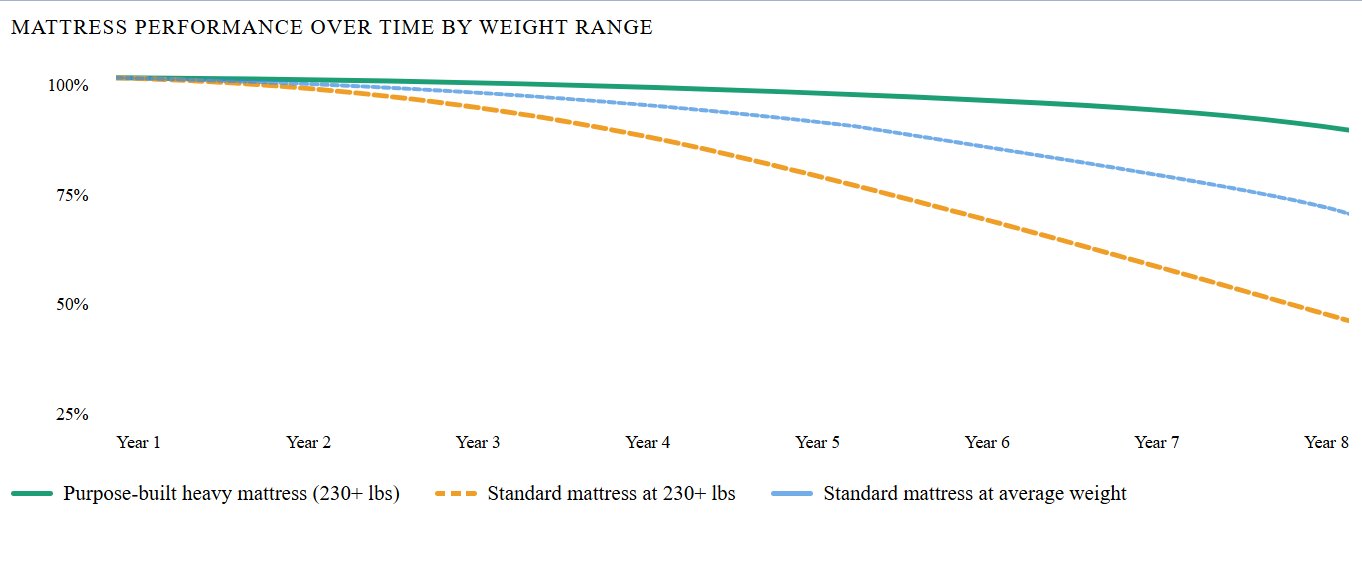
Foam compression. Standard comfort layer foam has a density of approximately 1.2 to 1.5 lbs per cubic foot. Under average-weight use, this foam maintains its feel for 6 to 8 years. Under sustained higher-weight pressure, the same foam compresses faster — measurably so above 200 lbs and significantly so above 230 lbs. A mattress that should last 8 years for an average-weight sleeper may begin losing its original feel at 3 to 4 years for a heavier one.
The foam does not fail suddenly. It softens gradually, which is why the problem is often attributed to other causes. Back pain that began appearing after a year or two of owning a mattress, or increasing hip sag that developed gradually, is almost always this pattern.
Coil fatigue. Budget and mid-range hybrids use coil gauges designed for average weight ranges. Higher sustained weight accelerates coil fatigue in the same way it accelerates foam compression. A coil system rated for 10 years of use at 160 lbs will reach the same fatigue point in 5 to 6 years at 240 lbs.
Edge support failure. Standard mattresses reinforce their perimeter with a single row of firmer edge coils or foam. For average-weight sleepers this is adequate. For heavier sleepers, the edge becomes a primary support point — sitting on the side of the bed, getting in and out, and sleeping close to the edge all apply greater force to the perimeter. Standard edge reinforcement is insufficient, and edge collapse is often the first visible sign that a mattress is failing for a heavier sleeper.
Weight Thresholds: When Does Construction Start to Matter?
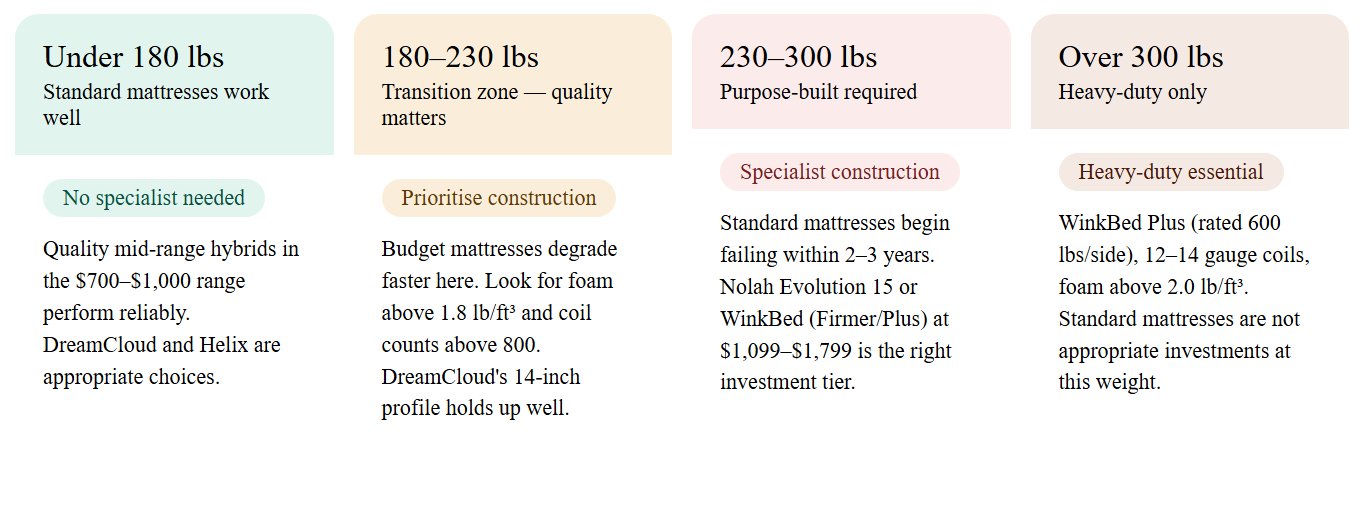
Not every heavier sleeper needs a purpose-built mattress. The relevant question is what weight range you’re in and what that means for your mattress choices.
Under 180 lbs: Standard mattresses work well. Quality mid-range hybrids from the $700-$1,000 tier perform reliably at this weight. The DreamCloud Hybrid, Helix Midnight, and similar options are appropriate choices.
180-230 lbs: This is the transition zone where construction quality begins to matter meaningfully. A premium mid-range hybrid with higher foam density and a quality coil core performs well. A budget mattress in this range will degrade noticeably faster than its warranty suggests. Prioritise foam density above 1.8 lbs per cubic foot and coil counts above 800 for a queen.
230-300 lbs: Standard mattresses are a poor investment at this weight. They will perform adequately for 1 to 3 years and then begin the gradual degradation described above. A purpose-built mattress with reinforced coil construction, high-density foam, and a 12 to 15 inch profile is the correct starting point. Expect to spend $1,100-$1,800 for a quality queen at this weight range.
Over 300 lbs: Purpose-built construction is essential. The WinkBed Plus and similar heavy-duty hybrids are specifically engineered for this weight range. Standard mattresses, even premium ones, will not hold their performance properties.
What Construction Actually Handles Higher Weight
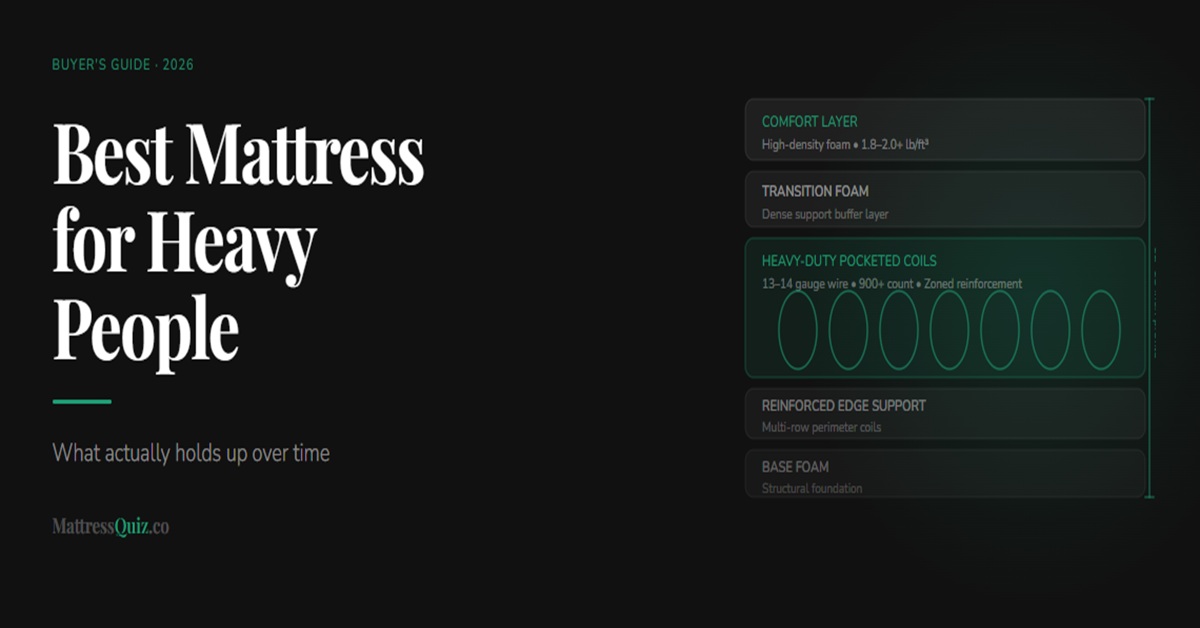
Foam density above 1.8 lbs per cubic foot. This is the single most important specification for heavier sleepers and the one least likely to appear in product listings.
Higher density foam resists compression more effectively and maintains its original feel for longer under sustained pressure. Quality mattresses built for heavier sleepers use 1.8 to 2.5 lb foam in their comfort layers. Standard mid-range mattresses use 1.2 to 1.5 lb foam. This difference is not visible and rarely discussed, but it is the primary determinant of long-term durability under heavier use.
Coil count and gauge calibrated for higher weights. A pocketed coil system with 800+ coils in a queen is the baseline. More importantly, the coil gauge (wire thickness) should be heavier than standard.
Lower gauge numbers mean thicker wire and greater resistance. Heavy-duty hybrids use 13 to 14 gauge coils vs the 15 to 16 gauge coils found in standard models. This is also rarely listed in product descriptions but directly determines how long the support core maintains its properties.
Height above 12 inches. A taller mattress profile allows for thicker comfort and transition layers without sacrificing support core depth. Most purpose-built heavy-duty mattresses are 13 to 15 inches tall. Standard mid-range mattresses are 10 to 12 inches. The extra height is not aesthetically driven — it reflects deeper, denser layers throughout.
Reinforced perimeter support. Purpose-built heavy-duty mattresses use multiple rows of edge coils or high-density foam encasements around the perimeter. This prevents the edge sag that accelerates on standard mattresses under heavier use and maintains the full sleeping surface rather than effectively reducing it as the edge becomes unusable.
Why Edge Support Matters More at Higher Weights
Edge support is mentioned in most mattress guides but rarely explained in terms of why it matters differently for heavier sleepers.
When you sit on the edge of a mattress to get up in the morning, you apply a concentrated force at the perimeter that is roughly equivalent to your full body weight on a very small surface area.
For a 160-pound sleeper, this is manageable with standard edge reinforcement. For a 260-pound sleeper, the same action applies 60 percent more force to an area that was not designed for it.
The consequence is visible edge compression that develops over months, which progressively reduces the usable sleep surface. A king mattress with edge collapse on both sides may effectively function as a queen in terms of usable area.
For a heavier sleeper who shares the bed, this compounds the motion isolation problem because both partners end up sleeping closer to the centre.
Good edge support also affects getting in and out of bed. A perimeter that holds firm makes it significantly easier to transfer from a sitting to standing position, which matters practically for many heavier sleepers and disproportionately for older ones.
Body Heat and Heavier Sleepers
Heavier bodies generate more heat during sleep than lighter ones. This is a straightforward metabolic reality — more mass produces more heat output. This means the cooling properties of a mattress matter more for heavier sleepers than average-weight guides suggest.
All-foam mattresses perform poorly for heavier hot sleepers specifically because the foam both traps heat and collapses faster under higher weight. The combination of thermal and structural failure accelerates in both directions.
A hybrid with pocketed coil airflow is the baseline recommendation for heavier sleepers who run warm. For heavier sleepers with serious heat issues, Bear Star Hybrid with its Celliant cover and coil ventilation is worth the consideration despite not being purpose-built for higher weights (it performs well up to approximately 250 lbs).
The Best Mattresses for Heavier Sleepers
WinkBed Plus: Best for Sleepers Over 250 lbs
WinkBed specifically designed the Plus as a separate product for sleepers over 250 lbs. It uses a heavy-duty tencel and latex hybrid construction with reinforced edge coils and a coil gauge calibrated for sustained higher-weight use.
The latex comfort layer is the key differentiator from standard foam-top hybrids. Latex resists the compression failure that foam undergoes at higher weights. It does not soften with heat the way memory foam does, which means it maintains its support properties more consistently throughout the night and over the lifespan of the mattress.
The Plus option addresses what no standard mattress can reliably deliver for sleepers over 250 lbs: support that remains consistent at year three the same way it performed at week one.
Best for: Sleepers over 250 lbs, any sleep position, back pain sufferers at higher weights, heavier couples. Queen price: $1,499-$1,799. Trial: 120 nights. Warranty: Lifetime.
Nolah Evolution 15: Best Purpose-Built Option for 180-300 lbs
The Nolah Evolution 15 is purpose-built for heavier sleepers and is the most complete option in our lineup for the 180 to 300 lb range.
The 15-inch profile includes a zoned pocketed coil core with heavier gauge coils in the lumbar and hip zones. The AirFoamICE comfort layer uses a higher foam density than standard Nolah models, specifically to resist the compression acceleration that occurs at higher weights. The three firmness options (Plush, Luxury Firm, and Firm) allow side sleepers, back sleepers, and stomach sleepers at heavier weights to select the appropriate construction for their position.
The 15-inch height is not cosmetic. It allows thicker comfort layers above a deeper coil core, both operating at the density needed for heavier weights. A standard 10-inch mattress simply cannot accommodate both without compromising one of them.
Best for: Sleepers 180-300 lbs, back and side sleepers with back pain, heavier sleepers who need position-specific firmness options. Queen price: $1,099-$1,299. Trial: 120 nights.
Saatva Classic (Firm): Best for Heavier Back and Stomach Sleepers
The Saatva Classic is not purpose-built for heavier sleepers the way WinkBed Plus and Nolah Evolution 15 are. But its dual coil system makes it one of the most structurally durable mattresses available, and for heavier back and stomach sleepers specifically, that durability matters.
The coil-on-coil construction uses offset coils in the base under individually pocketed coils in the support layer. This dual system distributes weight across more coil contact points than a single coil system, which reduces the compression per coil and extends the lifespan of the support layer significantly. The Firm option (8/10) is the right choice for heavier back and stomach sleepers.
White-glove delivery is included, which is a practical consideration for heavier mattresses at this profile.
Best for: Heavier back and stomach sleepers (180-280 lbs), heavier sleepers who also have back pain, buyers wanting white-glove delivery. Queen price: $1,595-$1,795. Trial: 365 nights.
DreamCloud Hybrid: Best for the 180-230 lb Transition Zone
At the 180-230 lb range where standard mattresses begin to show their limitations, the DreamCloud Hybrid occupies a useful position. It is not purpose-built for heavier sleepers, but its construction quality sits above standard mid-range mattresses — higher density foam, a quality pocketed coil system, and a 14-inch profile — which means it performs reliably at this weight range longer than most.
The 365-night trial is the longest in this price range and specifically valuable for heavier sleepers who need more time to assess how the mattress holds up under their weight. Degradation patterns that a lighter sleeper might not notice for two years can be assessed by a heavier sleeper in six to nine months.
Best for: Sleepers 180-230 lbs, back and combo sleepers, buyers wanting maximum trial length to assess long-term durability. Queen price: $649-$1,299. Trial: 365 nights.
Position-Specific Notes for Heavier Sleepers
Side sleepers over 200 lbs: The standard recommendation of medium to soft firmness for side sleepers needs modification at higher weights. The hip and shoulder compression that creates pressure points for lighter side sleepers is partially offset by the deeper sinkage that heavier sleepers experience on the same mattress. Start at medium (5-6) rather than soft to medium (4-5). Nolah Evolution 15 in Luxury Firm handles this well.
Back sleepers over 200 lbs: Lumbar sag — the primary failure mode for back sleepers — is more likely and faster-developing at higher weights. Move to firm (7) rather than medium-firm (6). WinkBed Plus or Saatva Classic Firm are the correct choices.
Stomach sleepers over 200 lbs: As covered in our stomach sleepers guide, higher weight pushes the pelvis down more aggressively, requiring firmer construction. Extra firm (8+) is the appropriate target. WinkBed Plus with extra edge reinforcement handles this best.
Heavier couples with a weight difference over 60 lbs: The heavier partner’s side will experience faster degradation on any shared mattress. A split king setup allows each partner to have a mattress appropriate for their individual weight. For couples who want to share a single mattress, the WinkBed Plus or Nolah Evolution 15 hold their properties more evenly across weight differences than standard constructions.
What Heavier Sleepers Should Avoid
Budget mattresses regardless of initial feel. A budget mattress that feels fine in the first month will compress significantly faster at higher weights. The foam density and coil gauge are simply not built for sustained heavier-weight use. This is the most expensive false economy in mattress buying.
All-foam mattresses. At higher weights, foam’s compression failure accelerates and there is no coil system to compensate. An all-foam mattress that lasts 7 years for an average-weight sleeper may feel significantly degraded within 2 to 3 years at 230+ lbs.
Mattresses under 12 inches. Mattresses below 12 inches in profile cannot accommodate both adequate comfort layers and a durable support core at the depth needed for higher weights. The comfort layer or the support core — sometimes both — will be compromised.
10-year warranties on mattresses marketed to heavier sleepers. A manufacturer confident in their construction for heavier use offers a lifetime warranty. A 10-year warranty on a mattress marketed specifically for higher weights is a meaningful signal about expected durability.
Frequently Asked Questions
At what weight do I need a special mattress?
The transition zone begins at approximately 180 lbs, where construction quality starts to affect long-term performance meaningfully. Above 230 lbs, purpose-built construction is the right investment. Above 250 lbs, it is essentially required for a mattress to maintain its performance properties over a reasonable lifespan.
What type of mattress is best for heavy people?
A hybrid with pocketed coils is the best construction for heavier sleepers across all positions. The coil system provides support that maintains its properties longer than foam under higher-weight use. Purpose-built heavy-duty hybrids like WinkBed Plus and Nolah Evolution 15 use heavier coil gauges and higher foam densities specifically calibrated for this weight range.
How thick should a mattress be for a heavy person?
At least 12 inches, and ideally 13 to 15 inches. Taller mattresses accommodate thicker comfort and transition layers without sacrificing support core depth. The Nolah Evolution 15 at 15 inches specifically addresses this.
Why does my mattress keep sagging in the middle?
Sagging at the centre of a mattress is the most common sign of foam compression failure. At higher weights, the comfort layer foam in the central sleep zone compresses faster than the surrounding areas. This is structural degradation rather than a defect, and it progresses gradually. It almost always indicates the mattress was not built with sufficient foam density for your weight range.
Can two people of very different weights share a mattress?
Yes, but with caveats. The heavier partner’s side will compress the comfort foam faster than the lighter partner’s side. A quality hybrid with high-density foam evens out this disparity better than a standard mattress. For couples with more than 80 lbs difference, a split king setup is the most honest long-term solution.
Find Your Specific Match
Our mattress quiz asks about your body weight alongside your sleep position, heat sensitivity, and budget to match you to the right construction rather than just the right firmness.
[Take the free quiz at MattressQuiz.co]
Affiliate disclosure: Some links in this article are affiliate links. We earn a small commission if you purchase through them at no extra cost to you. It never influences which products we recommend.
Mattress quiz finder
Find the mattress that fits you
Answer a few questions about how you sleep. Get scored matches from our catalog—not a generic roundup.
Start the free quiz