May 25, 2026 · MattressQuiz.co
Best Mattress for Couples: How to Solve the Right Problem (2026)
The best mattress for couples depends on which of four specific problems you're solving — motion transfer, temperature, firmness conflict, or weight disparity. Here's how to identify yours and fix it.
You go to sleep comfortable. Your partner rolls over at 3 a.m. You’re awake.
Or you’re perfectly comfortable and they’re sweating through the sheets.
Or you like firm and they like soft, and whatever mattress you’ve landed on is wrong for at least one of you every night.
The couples mattress question is actually four separate questions. Most guides treat it as one, recommend motion isolation as the solution, and produce a list of mattresses that may have nothing to do with your actual problem. This guide works differently. It identifies the four specific challenges couples face, explains what solves each one, and recommends mattresses from our lineup based on which problem you have.
The Four Couples Mattress Problems
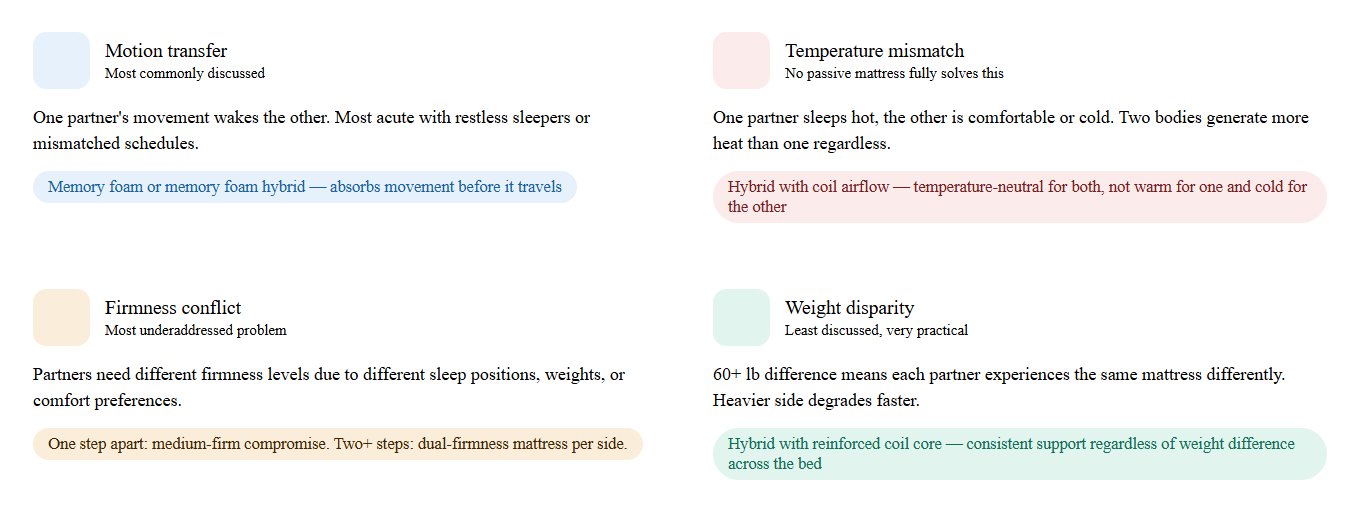
Before looking at any mattress, identify which of these describes your situation. Some couples have one. Many have two or three.
Problem 1: Motion transfer. One partner’s movement wakes the other. Getting in or out of bed, changing positions during the night, or restlessness on one side is felt on the other.
Problem 2: Temperature mismatch. One partner sleeps hot and the other sleeps at a comfortable temperature or cold. The hot sleeper wants airflow. The cool sleeper may not want a cooler surface. Finding a mattress that serves both is harder than it sounds.
Problem 3: Firmness conflict. You and your partner have genuinely different firmness preferences or, more commonly, genuinely different firmness needs based on your sleep positions and body weights. A side sleeper and a stomach sleeper sharing a bed need construction that would normally pull in opposite directions.
Problem 4: Weight disparity. One partner is significantly heavier than the other. On the same mattress, a heavier person compresses comfort layers more deeply than a lighter one. What one person experiences as medium-firm, the other may experience as too soft or too firm.
Most couples articles focus almost entirely on Problem 1. Problems 3 and 4 are where most couples actually struggle, and they are the least discussed.
Problem 1: Motion Transfer
Motion isolation is how well a mattress absorbs movement and keeps it contained to one side of the bed. A mattress with poor motion isolation transmits vibration across the surface. A mattress with good motion isolation allows one partner to move without the other noticing.
What causes poor motion isolation: Interconnected coil systems are the worst for this. When coils share a wire structure, any movement on one coil transfers across the network. Pocketed coils (each coil individually wrapped in fabric) perform significantly better because the fabric pockets dampen the movement before it can travel.
All-foam mattresses perform better than any coil system for motion isolation because foam absorbs and dissipates movement rather than transmitting it. Memory foam in particular is the single best material for motion containment.
What solves it: For couples where motion transfer is the primary complaint, a memory foam mattress or a memory foam hybrid is the strongest solution. Nectar Premier Copper, with its memory foam comfort layer over a pocketed coil base, addresses motion isolation well while avoiding the heat retention problem of all-foam construction. DreamCloud Hybrid also performs well here, with pocketed coils and a thick Euro-top that absorbs a meaningful amount of movement.
What does not solve it: Switching to a firmer mattress. Firmness has no relationship to motion isolation. A firm memory foam mattress isolates motion as well as a soft one. A firm innerspring mattress isolates motion poorly regardless of its quality.
Problem 2: Temperature Mismatch
Two bodies generate more heat than one. Even a couple where neither partner sleeps particularly hot will generate a combined thermal load that matters for mattress selection.
Add a hot sleeper and a neutral sleeper sharing a bed, and the problem becomes significant. The hot sleeper needs a mattress with genuine airflow. The neutral sleeper may not want a cooler surface that was engineered for their partner’s comfort.
The honest reality: There is no mattress that runs cold for a hot sleeper while running warm for a cool sleeper. Temperature mismatch is a fundamentally unsolvable problem with a single passive mattress. What you can do is choose a mattress that runs temperature-neutral, which is better for the hot sleeper than a foam mattress without actively penalising the cooler one.
What solves it: A hybrid with pocketed coils is the baseline. The coil airflow addresses the hot sleeper’s problem without making the surface cold. Bear Star Hybrid’s Celliant cover and GhostBed Flex’s PCM cover both go further and actively manage surface temperature.
Purple RestorePlus addresses this couple profile most effectively. The GelFlex Grid is genuinely temperature-neutral at the surface because it neither traps nor radiates heat. Both partners get a surface that stays closer to room temperature than foam or standard hybrid covers allow.
Active solutions: If temperature mismatch is severe — one very hot sleeper and one who gets cold easily — consider a dual-zone temperature regulation system (ChiliSleep, BedJet) added to a neutral hybrid mattress. These solutions are expensive ($800-$2,500 for the system itself) but they solve the problem directly in a way no passive mattress can.
Problem 3: Firmness Conflict
This is where most couples guidance fails completely.
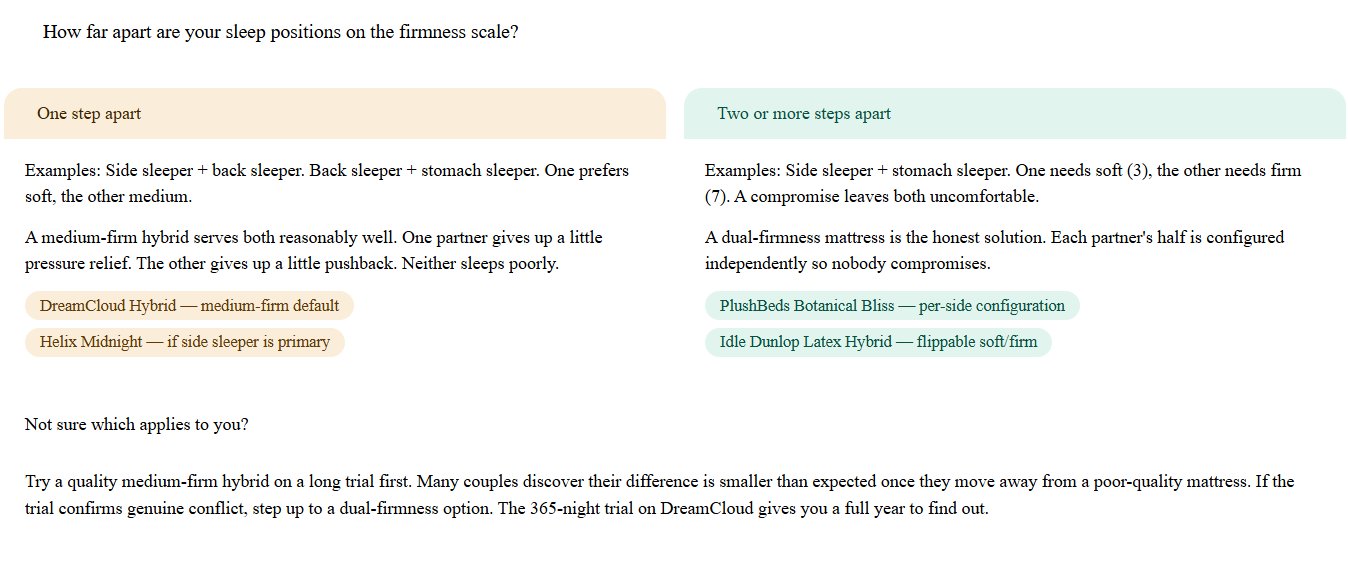
If you and your partner have different sleep positions, you may need genuinely different firmness levels. A side sleeper needs medium or softer. A back sleeper needs medium-firm. A stomach sleeper needs firm. If you’re sharing a standard mattress, someone is sleeping on the wrong firmness most nights.
Finding a compromise firmness: If the difference between your positions is one step (side sleeper and back sleeper, back sleeper and stomach sleeper), a medium-firm hybrid typically serves both reasonably well. The side sleeper gives up a little pressure relief. The back or stomach sleeper gives up a little pushback. Neither gets exactly what they need, but neither sleeps poorly.
If the difference is larger (side sleeper and stomach sleeper), the compromise position is genuinely uncomfortable. A stomach sleeper on medium gets lumbar sag. A side sleeper on firm gets shoulder pressure. This is the couple profile that most benefits from dual-firmness solutions.
Dual-firmness solutions:
PlushBeds Botanical Bliss allows the firmness and layer composition to be configured per side independently. This is the only mattress in our lineup that genuinely solves the firmness conflict at a construction level rather than asking both partners to compromise.
Idle Dunlop Latex Hybrid is flippable, with a soft side and a firm side. Partners with different preferences can flip their half to the side that suits them, or the couple can agree on one side for the whole mattress and flip it if preferences change.
WinkBed offers four distinct firmness options. Couples where both partners agree on a firmness direction but disagree on the exact level often resolve this by choosing the Softer option for a side-heavy couple or the Firmer option for a back-and-stomach couple, with the right choice bridging the gap between the two needs.
When dual-firmness is not the answer: Some firmness conflicts are overstated. Partners often discover their firmness difference is smaller than they expected when they try a quality medium or medium-firm hybrid. If you have not tried a high-quality medium-firm hybrid recently, do that before investing in a dual-firmness configuration.
Problem 4: Weight Disparity
This is the most overlooked couples problem and one of the most practically significant.
If one partner weighs significantly more than the other — a difference of 60 pounds or more — they are not experiencing the same mattress.
The heavier partner compresses the comfort layers more deeply. What feels like a medium to the lighter partner feels like a medium-soft or soft to the heavier one. The mattress may align correctly for the lighter partner and produce hip sag or shoulder sinkage for the heavier one depending on sleep position.
Over time, the heavier partner’s side of the mattress softens faster because the foam on their half is under more sustained compression. A mattress that felt equal for both initially will start to feel noticeably different on each side after a year of regular use.
What solves it:
A hybrid with a heavy-duty support core handles weight disparity better than all-foam construction. The coil support core does not differentiate between sides of the mattress, so the heavier partner’s side maintains better long-term support than the same position in foam.
Nolah Evolution 15, with its reinforced coil core and high-density comfort layer, is purpose-built for higher weight ranges and handles weight-asymmetric couples well because it provides consistent support regardless of how deeply either partner compresses into it.
DreamCloud Hybrid at its medium-firm (6/10) also handles weight disparity reasonably well for couples where the heavier partner is in the 180-240 lb range. Above 240 lbs, a purpose-built construction is the more reliable choice.
For couples with extreme weight disparity (one partner over 250 lbs and one under 150 lbs), a split king setup is the most honest solution. Each partner gets a mattress appropriate for their body.
What All Couples Need: Size and Edge Support
Beyond the four specific problems, two things matter for any couple sharing a bed.
Size. A queen (60 x 80 inches) gives each partner 30 inches of width. A king (76 x 80 inches) gives each partner 38 inches. If either partner moves significantly during the night, the additional 8 inches per person on a king makes a real difference in sleep quality. For tall partners (over 6 feet), the 80-inch length of both queen and standard king works. A California King (72 x 84 inches) adds 4 inches of length for very tall sleepers but reduces width by 4 inches compared to a standard king.
Edge support. Couples who sleep close to the edges of a mattress need confident edge support. A mattress with poor edge support creates a drop-off effect at the perimeter, which limits the usable sleeping surface to the centre and feels unstable when sitting on the side of the bed. Quality hybrids with a reinforced edge coil row (WinkBed, DreamCloud, Saatva Classic) address this. All-foam mattresses are generally weaker at the edges.
Our Recommendations by Couples Problem
Primary issue is motion transfer: Nectar Premier Copper. Memory foam comfort layer over pocketed coils. The strongest motion isolation in our hybrid lineup.
Primary issue is heat: Bear Star Hybrid for one hot sleeper. Purple RestorePlus for a couple where both run warm or where a temperature-neutral surface helps both.
Firmness conflict, one step apart: DreamCloud Hybrid at medium-firm covers most one-step firmness conflicts adequately. Helix Midnight for couples where the side sleeper’s needs are primary.
Firmness conflict, two or more steps apart: PlushBeds Botanical Bliss for per-side firmness customisation. Idle Dunlop Latex Hybrid as a flippable lower-cost alternative.
Weight disparity (60+ lb difference): Nolah Evolution 15 for couples where the heavier partner is 180+ lbs. DreamCloud Hybrid for couples where the heavier partner is 150-240 lbs.
No specific problem, general couple: DreamCloud Hybrid. It handles motion isolation adequately, has good edge support, comes in at a fair price, and the 365-night trial gives both partners enough time to make a genuine assessment.
When to Consider a Split King
A split king is two twin XL mattresses placed side by side on a king-sized frame. Each partner gets a completely independent mattress surface.
It is the right choice in four situations: significant weight disparity (over 80 lbs difference), incompatible firmness needs (side sleeper and stomach sleeper), severe and persistent motion transfer that no standard hybrid resolves, or individual health conditions requiring specific construction (sciatica on one side, severe hot sleeping on the other).
The cost is higher than a standard king because you are buying two mattresses. The frame needs to accommodate the split. And some couples find the centre seam affects their sleep when they lie close together. For couples with genuinely incompatible sleep needs, the split king is the most honest solution to a problem that single-mattress compromises can only partially address.
Frequently Asked Questions
What is the best mattress for couples?
It depends on which problem you are solving. For motion transfer, a memory foam hybrid like Nectar Premier Copper. For heat, Bear Star Hybrid or Purple RestorePlus. For firmness conflict, PlushBeds Botanical Bliss (per-side customisation) or DreamCloud Hybrid (medium-firm compromise). For most couples without a specific extreme need, DreamCloud Hybrid is the strongest all-round starting point at a fair price.
Is a king or queen better for couples?
A king gives each partner 8 more inches of width than a queen. If either partner moves significantly during the night, or if you both simply want more personal space, the king is worth the additional cost. If your bedroom is not large enough for a king comfortably (a king needs roughly a 10 x 12 foot room minimum to avoid feeling cramped), a queen is the correct choice. Space around the bed matters for the room to function.
What is the best mattress for couples with different sleeping positions?
A medium-firm hybrid handles one-step position differences (side and back, back and stomach) reasonably well. For two-step differences (side and stomach), look at dual-firmness options. PlushBeds Botanical Bliss allows each side to be configured independently. If only one partner’s position is a significant driver of the mattress selection, choose the mattress that serves that person’s position and treat the other partner as a secondary consideration.
Does mattress size affect motion isolation?
Yes, indirectly. A larger mattress means movement travels further before reaching the other partner’s sleep zone. On a king, a partner rolling over in their sleep zone has their movement dissipate somewhat before it crosses 76 inches to the other side. On a queen at 60 inches, the same movement has less distance to travel. A king does not replace good motion isolation but it reduces the problem’s severity for the same mattress construction.
What is a mattress quiz for couples?
A mattress quiz for couples asks about both partners’ sleep profiles separately — position, body weight, heat sensitivity, and firmness preference — and finds a mattress that works for both profiles simultaneously. Our quiz at MattressQuiz.co does this. It asks about partner weight and position specifically to factor in the weight disparity and firmness conflict problems that standard individual quizzes miss.
Find the Right Match for Both of You
Our mattress quiz asks about both partners’ sleep profiles and finds a mattress that works for the combination, not just one of you.
[Take the free quiz at MattressQuiz.co]
Affiliate disclosure: Some links in this article are affiliate links. We earn a small commission if you purchase through them at no extra cost to you. It never influences which products we recommend.
Mattress quiz finder
Find the mattress that fits you
Answer a few questions about how you sleep. Get scored matches from our catalog—not a generic roundup.
Start the free quiz