May 25, 2026 · MattressQuiz.co
Best Mattress for Back Sleepers: Why This Is Easier Than You Think (2026)
Back sleeping is the most forgiving sleep position for mattress selection. Here's what back sleepers actually need, the two failure modes to avoid, and the best mattresses from our lineup in 2026.
Most mattress guides treat back sleeper recommendations as a complicated decision requiring extensive analysis. It’s not.
Back sleeping is the most forgiving sleep position when it comes to mattress selection. Your weight is distributed more evenly than in any other position, you have fewer concentrated pressure points than a side sleeper, and the neutral spine position is easier to maintain than stomach sleeping. If you sleep primarily on your back and you’re buying a quality mid-range hybrid, the odds are very good that it will work for you.
What the guides miss is that the simplicity of back sleeping also makes the mistakes very specific. There are two things that go wrong with the wrong mattress, and both are avoidable once you know what to look for.
This guide explains the mechanics of back sleeping, the two failure modes that cause problems, how body weight modifies what you need, and which mattresses from our lineup perform best for back sleepers.
Why Back Sleeping Is Different From Other Positions
When you lie on your back, your body weight is distributed across your shoulders, ribcage, lower back, hips, and legs. No single area takes the concentrated load that a side sleeper’s shoulder does, or the sustained pressure that a stomach sleeper places on the lumbar.
This means back sleepers can sleep comfortably on a wider range of firmness levels than any other position. A side sleeper on the wrong firmness wakes up with shoulder pain. A stomach sleeper on the wrong firmness develops lower back problems over time. A back sleeper on a mattress that’s one step from ideal in either direction will usually sleep adequately, even if not optimally.
The flip side: because the consequences of getting it wrong are less immediate for back sleepers, many people spend years on a mattress that’s slightly wrong for their body without ever identifying it as the cause of their morning stiffness or their occasional poor sleep.
The Two Failure Modes for Back Sleepers
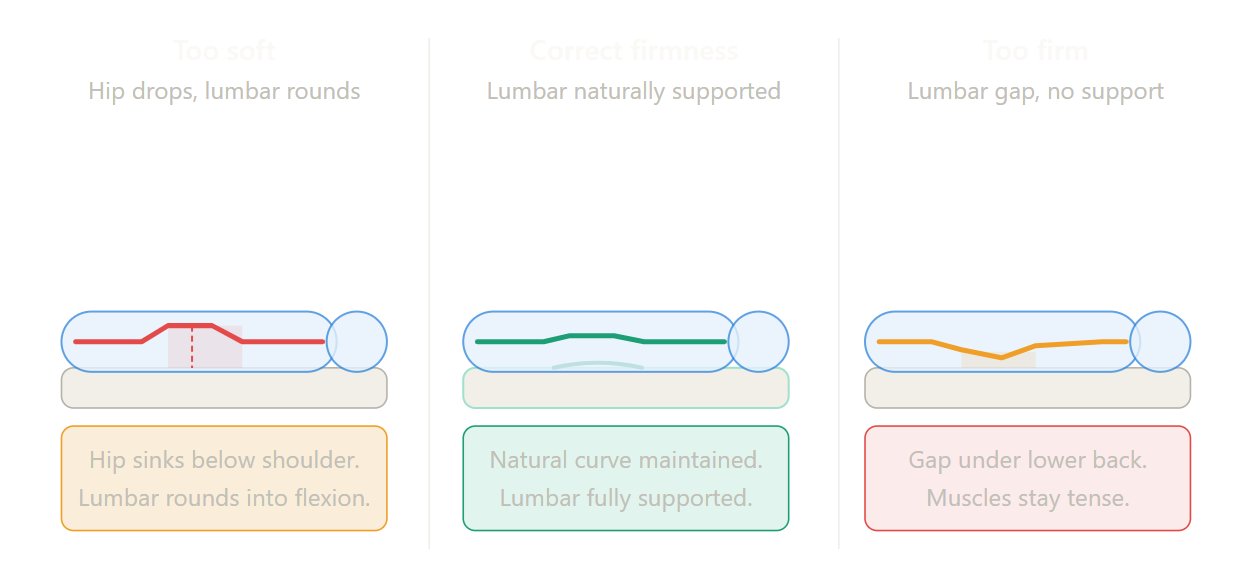
Back sleeping fails in one of two specific ways.
Failure mode 1: Lumbar sag. When a mattress is too soft for your body weight, your hips and pelvis sink deeper than your upper back. The spine curves into posterior flexion at the lumbar. Your lower back muscles stay partially contracted trying to compensate, and you wake up with lower back stiffness that improves as you move around but returns the next morning.
This is the most common mattress problem for back sleepers and the most consistently underdiagnosed. If your lower back is stiff every morning and loosens within 30-60 minutes of waking, your mattress is too soft for your weight.
Failure mode 2: Lumbar gap. When a mattress is too firm to contour at all, the natural lumbar curve has no support beneath it. The shoulder and hip are held at the surface, but the lower back hangs in a slight arch with no material filling the space. The lumbar muscles must work to maintain the position, creating the same tension as Failure Mode 1 but from the opposite direction.
This is less common than Failure Mode 1 because most mattresses in the mid-range have enough contouring to fill the lumbar gap. It appears most often when back sleepers try a very firm mattress on the advice that firm is better for the back — an oversimplification, as covered in our firmness guide.
The solution to both failure modes is the same: a mattress with enough contouring to fill the lumbar curve, enough support to prevent the hips from sinking below the spine line, and a coil core that maintains these properties over time.
Firmness for Back Sleepers

Medium-firm, approximately 5.5 to 6.5 on the 10-point scale, is the right starting point for back sleepers. This recommendation applies most accurately to average-weight sleepers between 130 and 180 pounds. Body weight adjusts this in both directions.
Under 130 lbs: You don’t compress comfort layers deeply. A mattress rated medium-firm will feel firm to you. Start at medium (5) to ensure the comfort layer fills the lumbar gap rather than holding you rigidly at the surface.
130-180 lbs: Standard medium-firm recommendations apply well. Most mattresses in this range perform as rated for this weight bracket.
180-240 lbs: You compress comfort layers more deeply than their firmness rating assumes. A medium-firm mattress will feel like a medium, and may allow gradual hip sag as the foam softens with use. Start at firm (7) and let body weight bring it into the medium-firm range functionally.
Over 240 lbs: A standard medium-firm mattress is likely to produce Failure Mode 1 within months as foam compresses under sustained higher-weight pressure. A purpose-built mattress with a reinforced coil core is the correct construction at this weight. Nolah Evolution 15 is the relevant option from our lineup.
The One Feature That Changes Everything for Back Sleepers
Back sleepers benefit more from zoned lumbar support than any other sleep position.
Standard mattresses use the same firmness across the entire surface. Zoned mattresses use thicker, firmer coils or denser foam in the lumbar region specifically, with softer zones under the shoulders and hips. For a back sleeper, this is close to ideal construction. The lumbar zone holds the lower back in its natural curve. The shoulder zone allows slight contouring without creating pressure. The hip zone provides just enough give to prevent the pelvis from being held rigidly at the surface.
WinkBed and Saatva Classic both use different construction approaches to achieve lumbar zoning. WinkBed varies the coil gauge by zone. Saatva uses Lumbar Zone Quilting, a reinforced foam section sewn directly into the mattress cover at the lumbar. Both work, and both produce noticeably better results for back sleepers than a standard uniform-construction mattress at the same firmness level.
If you have no back pain and are simply looking for the most comfortable mattress as a back sleeper, zoned support is a useful upgrade but not a strict requirement. If you have any existing lower back pain or stiffness, it moves from upgrade to essential.
The Best Mattresses for Back Sleepers
Saatva Classic: Best Overall for Back Sleepers
Saatva Classic is the most consistently top-rated mattress for back sleepers across independent testing, and the construction explains why.
The dual coil system — offset coils beneath pocketed coils — provides a level of support consistency that single coil systems can’t match. The Lumbar Zone Quilting adds dedicated lower back support at the surface level. The European pillow top provides enough contouring to fill the lumbar gap without allowing hip sag. These three elements work together specifically in the way back sleeping requires.
The Luxury Firm option (5.5/10) is the right choice for most back sleepers in the 130-230 lb range. The Firm option (8/10) suits heavier back sleepers and those who also stomach sleep. The Plush Soft is not recommended for back sleepers unless they are very lightweight (under 120 lbs) and have a pronounced lumbar curve.
White-glove delivery is included. Old mattress removal is available. For back sleepers willing to invest in the best construction available for their position, this is the standard recommendation.
Best for: Back sleepers 130-280 lbs, chronic lower back pain, back sleepers who also stomach sleep (choosing Firm), buyers wanting white-glove delivery. Queen price: $1,595-$1,795. Trial: 365 nights.
WinkBed: Best for Back Sleepers with Back Pain
Where Saatva achieves lumbar zoning through the cover layer, WinkBed achieves it through the coil system. The lumbar zone uses a heavier coil gauge than the shoulder and hip zones. This creates structural pushback specifically where the back needs it, not just softer padding on top.
For back sleepers with existing lower back pain, this coil-level zoning is more durable than foam-level solutions. Foam softens over time. Coil gauge doesn’t. The support the WinkBed provides on day one is functionally the same as the support it provides after three years of regular use.
The four firmness options cover every back sleeper profile. Medium (5.5/10) for lighter back sleepers or those who also side sleep. Luxury Firm (6.5/10) for most back sleepers. Firmer (7.5/10) for back sleepers who are heavier or have significant lumbar pain. Plus for back sleepers over 300 lbs.
The lifetime warranty is a genuine statement about construction confidence.
Best for: Back sleepers with lower back pain, 150-300+ lbs, stomach and back combo sleepers, anyone prioritising long-term durability of support. Queen price: $1,499-$1,799. Trial: 120 nights.
DreamCloud Hybrid: Best Value for Back Sleepers
For back sleepers without specific pain concerns and a budget under $1,000, the DreamCloud Hybrid is the clearest recommendation.
It sits at medium-firm (6/10) out of the box, which lands in the ideal range for average-weight back sleepers. The Euro-top comfort layer provides enough contouring to fill the lumbar gap. The pocketed coil core holds the hips level. The construction is not purpose-built for back sleepers the way Saatva and WinkBed are, but for the profile it targets — 150-240 lbs, no existing back pain — it performs well consistently.
The 365-night trial is the best risk-reduction tool in this price range. If the mattress turns out to be wrong for your specific body, a year is more than enough time to identify it and return it.
Best for: Back sleepers 150-240 lbs with no specific pain concerns, combo sleepers who spend most time on their back, buyers wanting maximum trial length at this price. Queen price: $649-$1,299. Trial: 365 nights.
Nolah Evolution 15: Best for Heavy Back Sleepers
Back sleepers over 180 lbs face a specific durability problem with standard mattresses. The hips apply sustained pressure on the comfort foam over time, and standard foam densities compress progressively. A mattress that held the hips level at purchase starts allowing gradual hip sag as the foam breaks down.
Nolah Evolution 15 uses a 15-inch profile with a heavy-duty coil core and high-density AirFoamICE comfort layer built specifically for higher weight ranges. The construction maintains its support properties under sustained higher-weight compression in a way that standard mid-range mattresses don’t.
For back sleepers over 180 lbs, the Luxury Firm (6.5/10) option is the right choice. It performs as rated under higher body weight rather than feeling progressively softer over time.
Best for: Back sleepers over 180 lbs, particularly 200-300 lbs, back and combo sleepers at higher weights. Queen price: $1,099-$1,299. Trial: 120 nights.
Cocoon by Sealy Chill: Best for Brand-Aware Back Sleepers on a Budget
For back sleepers who recognise the Sealy name and want that brand association at a price under $1,000, the Cocoon by Sealy Chill is a solid choice.
The Chill Hybrid in Firm (7/10) is specifically well-suited to back sleepers. Sealy’s 140+ years of coil construction knowledge shows in the support core, and the phase-change Chill cover addresses moderate heat sensitivity. The simplicity of having just two options (Soft and Firm) removes the decision fatigue of choosing between five firmness levels.
It is not purpose-built for back sleepers with specific pain needs the way Saatva and WinkBed are. For straightforward, average-weight back sleeping with Sealy brand confidence, it delivers.
Best for: Back sleepers 130-220 lbs with no specific pain, Sealy brand-aware buyers, mild heat sensitivity. Queen price: $749-$999. Trial: 100 nights.
Back Sleepers with Specific Conditions
Lower back pain: See our full back pain guide. The short answer is WinkBed (zoned coil construction) or Saatva Classic (Lumbar Zone Quilting) at medium-firm to firm. DreamCloud handles mild morning stiffness. For chronic pain, the first two options are the correct choice.
Snoring: Back sleeping is the position most associated with snoring because the tongue and soft palate fall backward. An adjustable base that elevates the head slightly (10-30 degrees) reduces snoring more than any mattress choice. If you share a bed with a partner who snores primarily when on their back, an adjustable base attachment is worth investigating before changing the mattress.
Pregnancy: Back sleeping is generally not recommended after the first trimester due to the weight of the uterus on the vena cava. This is a medical matter and should be discussed with your OB. If you are in early pregnancy and are a back sleeper, the mattress recommendations above apply normally.
Older sleepers: Back sleeping is generally the recommended position for older adults because it reduces pressure on joints compared to side sleeping and eliminates the lumbar strain of stomach sleeping. Getting in and out of bed is the practical challenge. Look for good edge support (WinkBed and Saatva both perform well here) and consider an adjustable base that raises the head slightly to assist with getting up.
What Back Sleepers Should Avoid
Very soft mattresses (3-4/10). These are designed for side sleepers with significant pressure relief needs. On a back sleeper, a soft mattress will produce Failure Mode 1 (hip sag) regardless of body weight or brand quality.
Budget all-foam mattresses. The support core of a budget foam mattress degrades faster under the sustained hip pressure of back sleeping than a coil system. Back sleeping is where the coil-vs-foam construction difference matters most for long-term durability.
Pillow-top mattresses without adequate support cores. Some pillow-top mattresses prioritise the plush surface feel over the support core underneath. The plush feel is appealing but back sleepers need the support core to do real work. Check the coil count and foam density in the base, not just the comfort layer.
Frequently Asked Questions
What firmness is best for back sleepers?
Medium-firm, approximately 5.5 to 6.5 on the 10-point scale, works for most back sleepers between 130 and 180 lbs. Lighter sleepers should go slightly softer to ensure lumbar contouring. Heavier sleepers should go firmer because they compress comfort layers more deeply than the firmness rating assumes. Body weight is the most important modifier of the medium-firm starting point.
Is memory foam or hybrid better for back sleepers?
Hybrids are generally better for back sleepers because the pocketed coil core provides more consistent long-term support than foam bases, and the hip pressure of back sleeping degrades foam faster than the distributed pressure of other positions. Memory foam can work well for back sleepers if it’s high-density and the sleeper is in the average weight range, but for durability and long-term alignment, a hybrid is the stronger choice.
Do back sleepers need lumbar support?
Back sleepers benefit more from lumbar zoning than any other sleep position. The lumbar region in back sleeping requires specific support — not just the same firmness as the rest of the mattress. If you have existing lower back pain or stiffness, zoned lumbar support moves from useful to essential. WinkBed and Saatva Classic are the best options from our lineup with genuine lumbar zoning built into the construction.
Can back sleeping cause lower back pain?
Back sleeping itself does not cause lower back pain. An incorrect mattress for your weight and body type is what produces lower back pain in back sleepers. Specifically, a mattress too soft for your weight allows hip sag that strains the lumbar over hours of sleep. Switching to a firmer, properly supported surface typically resolves morning lower back stiffness within two to four weeks.
Is back sleeping actually better than other positions?
For spinal alignment, yes. Back sleeping keeps the spine in its most natural neutral position and distributes weight more evenly than either side or stomach sleeping. It is the position most consistently recommended by physiotherapists and orthopaedic specialists. The main limitation is that it is associated with increased snoring and is not recommended during pregnancy after the first trimester.
Find Your Specific Match
The recommendations above work for most back sleeper profiles. Your exact ideal match also depends on your heat sensitivity, whether you share the bed, and any specific health conditions.
Our mattress quiz factors all of this in and gives you a personalised recommendation in about two minutes.
[Take the free quiz at MattressQuiz.co]
Affiliate disclosure: Some links in this article are affiliate links. We earn a small commission if you purchase through them at no extra cost to you. It never influences which products we recommend.
Mattress quiz finder
Find the mattress that fits you
Answer a few questions about how you sleep. Get scored matches from our catalog—not a generic roundup.
Start the free quiz