May 26, 2026 · MattressQuiz.co
Nectar vs DreamCloud: Two Brands, One Parent Company, Different Beds (2026)
Nectar and DreamCloud are owned by the same parent company. Their beds are genuinely different. Here's the honest breakdown of what you're actually choosing between and who wins for each profile.
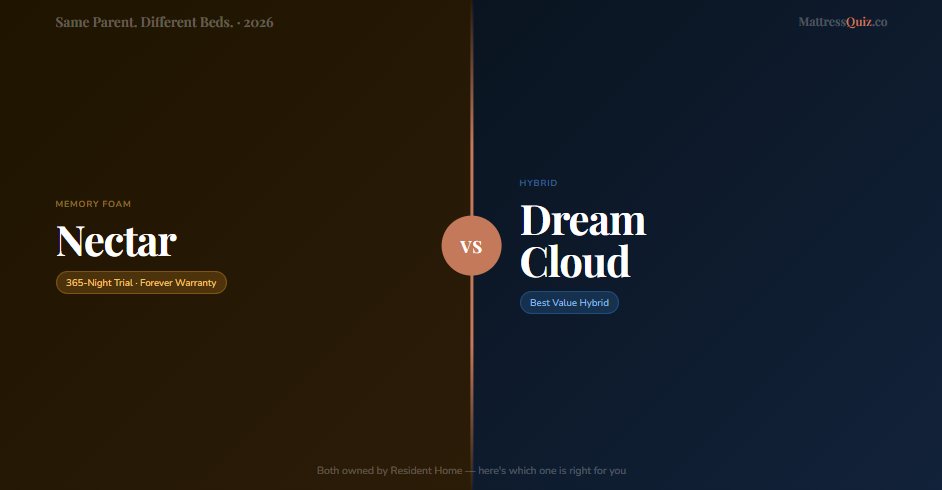
Before anything else: Nectar and DreamCloud are both owned by Resident Home, the same parent company. They share customer service infrastructure, the same 365-night trial policy, and the same Forever warranty terms across both brands.
This does not mean the mattresses are the same. They are built differently and perform differently. But it is the first piece of context most buyers do not have, and it changes how you should think about choosing between them.
You are not choosing between two competing companies trying to beat each other. You are choosing between two product lines with different design philosophies, owned by the same organisation, aimed at different buyer profiles.
What You Are Actually Choosing Between
The comparison changes depending on which Nectar model you’re considering.
Nectar Flagship vs DreamCloud Hybrid is a comparison between two different mattress categories. Nectar’s flagship is all-foam — no coils, no internal airflow, slower response, superior motion isolation. DreamCloud Hybrid has a pocketed coil core — airflow, responsiveness, better edge support, faster response. These are fundamentally different constructions that behave differently for different sleepers.
Nectar Premier Copper vs DreamCloud Hybrid is a more direct comparison. Both are hybrids. Both use pocketed coil support cores over foam comfort layers. The differences are in the comfort layer (copper-infused memory foam vs cashmere Euro-top), the profile height (12” vs 14”), and the specific firmness calibration.
We carry the Nectar Premier Copper in our affiliate lineup. This guide covers both comparisons, but the Premier Copper vs DreamCloud is the more relevant head-to-head for buyers who have already decided they want a hybrid.
Nectar Flagship vs DreamCloud Hybrid
Construction
The Nectar flagship uses multiple layers of polyfoam and gel memory foam with no coil system. It is the definition of an all-foam mattress. The gel infusion reduces heat retention compared to standard memory foam but does not eliminate it — the absence of a coil core means there are no air channels for heat to escape through.
The DreamCloud Hybrid uses a pocketed coil support core with foam comfort layers and a cashmere-blend quilted Euro-top. The coil core creates passive ventilation through the mattress, which is the primary reason it sleeps cooler than the Nectar flagship.
Feel
The Nectar flagship has the classic slow-sink memory foam feel. You sink in gradually, the foam conforms to your body shape, and repositioning requires slightly more effort than a responsive hybrid. This is the feel many side sleepers specifically seek — the sense of being cradled rather than pushed back against.
The DreamCloud Hybrid has a responsive, hotel-quality feel. The Euro-top provides plush surface cushioning but the coil core underneath creates pushback and makes repositioning easy. You sleep on the mattress rather than in it.
Who wins this comparison
Nectar flagship wins for: Sleepers under 180 lbs who primarily sleep on their side or back and want memory foam feel. Couples where one partner is a light sleeper and motion transfer is the primary concern. Buyers whose budget ceiling is under $700.
DreamCloud Hybrid wins for: Back and combination sleepers. Sleepers over 180 lbs. Hot sleepers. Buyers who want better edge support. Buyers who want a responsive rather than contouring surface.
Nectar Premier Copper vs DreamCloud Hybrid
This is the more direct comparison for buyers considering a hybrid in the $800-$1,000 range. Both have pocketed coil cores. The differences are material and meaningful.
Comfort Layer: Copper Foam vs Cashmere Euro-top
The Nectar Premier Copper uses copper-infused memory foam as the primary comfort layer. Copper infusion provides modest heat management improvement over standard memory foam — it is better than unmodified memory foam at dispersing heat but it does not produce the passive airflow that a hybrid’s coil core does. It is a legitimate improvement over the standard Nectar, not a marketing-only claim.
The DreamCloud’s cashmere-blend Euro-top provides a plush, soft-landing surface quality that memory foam, copper-infused or otherwise, does not replicate. The Euro-top feel is more responsive and less contour-heavy than a memory foam comfort layer.
Who each is built for
The Nectar Premier Copper is built for sleepers who specifically want the memory foam enveloping feel but need better cooling than the all-foam Nectar provides. The hybrid construction gives it better airflow than the all-foam Nectar. The copper-infused comfort layer gives it better surface heat management than standard memory foam. It is the bridge product between an all-foam Nectar and a different-feel hybrid.
The DreamCloud Hybrid is built for a broader profile — back and combination sleepers, any weight, with a default-good feel that suits the widest range of buyers.
The foam feel distinction
This is the clearest decision point between these two hybrids. If you specifically want the contouring, hugging sensation of memory foam in a hybrid format, the Nectar Premier Copper delivers it. If you want a responsive, plush-but-pushback hybrid that does not have the slow-sink quality of memory foam, the DreamCloud delivers it.
Both are hybrids. Both sleep cooler than all-foam options. They feel different in ways that matter.
Who Should Buy Nectar (Either Model)
Sleepers who love memory foam feel and refuse to give it up. The Nectar flagship and Premier Copper both preserve the slow-sink contouring quality that memory foam loyalists specifically want. DreamCloud does not. If you have slept on memory foam, liked it, and are not interested in a different feel, Nectar is the logical choice.
Side sleepers under 180 lbs with significant pressure issues. The Nectar’s deep contouring at the shoulder and hip is more pronounced than DreamCloud’s Euro-top. Lightweight side sleepers with genuine hip or shoulder pressure pain often prefer it.
Couples where motion isolation is the primary concern. The Nectar flagship has superior motion isolation to any hybrid. The Premier Copper — as a hybrid — is comparable to DreamCloud, but the flagship all-foam Nectar is noticeably better. If your partner’s movement wakes you up consistently, the all-foam Nectar resolves this more completely than either hybrid.
Budget-conscious buyers. The Nectar flagship at $499-$699 on sale is the most affordable 365-night trial mattress in the market. For a buyer whose ceiling is under $700, it is the strongest quality option available.
Who Should Buy DreamCloud
Back and combination sleepers. DreamCloud’s medium-firm (6/10) construction and responsive Euro-top are the natural fit for back sleepers and those who shift between back and side. The coil pushback keeps the lumbar supported without the sinking quality that memory foam produces in back sleeping.
Sleepers over 180 lbs. At higher weights, memory foam compresses more aggressively and its support degrades faster. DreamCloud’s 14-inch coil hybrid holds up under higher weight more reliably than Nectar’s 12-inch foam construction. For heavier buyers choosing between these two brands, DreamCloud is the clear recommendation.
Hot sleepers who still want some contouring. DreamCloud is not a purpose-built cooling mattress (Bear Star Hybrid or GhostBed Flex are better for severe heat issues), but its coil core provides passive airflow that the Nectar all-foam cannot match. For a moderate hot sleeper who also wants pressure relief, it bridges the gap.
Buyers who want maximum value per dollar at the hybrid tier. At $649-$899 on a queen with a 14-inch profile, cashmere-blend cover, pocketed coil system, lifetime warranty, and 365-night trial, DreamCloud’s sale pricing is exceptional. No comparable hybrid at this price point matches the combination of construction quality and consumer protections.
The Same-Parent Implication
Since both brands are owned by Resident Home, the policy terms are structurally similar because they are set by the same organisation. The 365-night trial on both brands uses the same return process. The Forever warranty on both brands has the same coverage terms.
This also means the customer service experience is likely to be similar across both brands — both in quality when things go well and in the limitations that exist when they don’t. If you have had a specific negative experience with one brand’s customer service, that is useful information about both brands.
It does not change which mattress is right for your body. Both are genuinely different products. But it should factor into how you think about brand loyalty arguments between the two.
Price Comparison
Nectar Flagship: $499-$699 queen on sale, $999-$1,199 listed. Best value in the 365-night trial category.
Nectar Premier Copper: $799-$999 queen on sale, $1,399 listed. Sits between the Nectar flagship and DreamCloud on price.
DreamCloud Hybrid: $649-$899 queen on sale, $1,299 listed. During major sale events (Memorial Day, Labor Day, Black Friday) it has dropped to $599.
At comparable sale pricing, the three options are within $100-$200 of each other in the $699-$899 range. The DreamCloud’s 14-inch profile and cashmere cover justify its premium over the Nectar flagship. The Nectar Premier Copper sits in a similar range to DreamCloud but with a different material trade-off.
Head-to-Head Performance
Cooling: Advantage DreamCloud. Coil core airflow beats both Nectar constructions on ventilation. Nectar Premier Copper (copper infusion + coil hybrid) is significantly better than Nectar flagship but behind DreamCloud on cooling.
Motion isolation: Advantage Nectar Flagship. All-foam construction absorbs movement better than any hybrid. Nectar Premier Copper and DreamCloud are comparable as pocketed coil hybrids.
Pressure relief for side sleepers: Advantage Nectar (both models). Memory foam contouring provides more shoulder and hip cushioning than DreamCloud’s Euro-top at the side-sleeping profile.
Back sleeping support: Advantage DreamCloud. Coil pushback and medium-firm construction hold lumbar alignment better than either Nectar option.
Responsiveness: Advantage DreamCloud. Euro-top over coils responds faster than memory foam comfort layers.
Edge support: Advantage DreamCloud. 14-inch coil hybrid has better perimeter support than 12-inch Nectar constructions.
Durability at higher weights: Advantage DreamCloud. 14-inch coil hybrid with cashmere cover holds its properties longer under 180+ lb sustained use.
The Verdict
Buy Nectar (flagship) if: Budget is under $700. Memory foam feel is specifically what you want. Motion isolation is your primary concern. You are a lighter side sleeper under 160 lbs.
Buy Nectar Premier Copper if: You want the memory foam contouring feel in a hybrid format with better cooling than the all-foam Nectar. You are a side sleeper under 210 lbs who runs moderately warm.
Buy DreamCloud Hybrid if: You are a back or combination sleeper. You are over 180 lbs. You sleep hot. You want the maximum coil depth and profile for the money. You want the clearest edge support of the three options.
The honest framing: Same parent company, genuinely different products. Nectar for foam-feel loyalty and motion isolation. DreamCloud for every profile where a responsive hybrid outperforms all-foam.
Frequently Asked Questions
Are Nectar and DreamCloud the same company?
They are owned by the same parent company, Resident Home. They are separate brands with distinct product lines, different constructions, and different target profiles. The shared ownership explains why both brands have identical 365-night trials and Forever warranties — those policies are set at the parent company level.
Which is better for couples, Nectar or DreamCloud?
Depends on the couple’s primary concern. If one partner’s movement wakes the other, Nectar’s all-foam construction provides better motion isolation. If temperature is the primary issue, DreamCloud’s hybrid coil construction sleeps cooler. If one partner is a back sleeper and the other a side sleeper, DreamCloud accommodates back sleeping better and the DreamCloud’s responsive feel creates less compromise for both positions.
Is the Nectar Premier Copper worth the extra cost over the standard Nectar?
For sleepers who sleep hot or are in the 150-210 lb range, yes. The hybrid coil construction adds airflow that the all-foam Nectar does not have, and the copper infusion provides additional surface heat management. The coil core also supports higher body weights more durably than the all-foam base. For lightweight cool sleepers who do not have heat issues, the standard Nectar at $200-$300 less serves equally well.
Which mattress has the better warranty?
Both brands offer a Forever warranty (lifetime). Since both are owned by Resident Home, the warranty terms are structurally identical. Read the fine print on both — coverage for sagging beyond 1.5 inches, foundation requirements, and the one-return-per-household policy are consistent across both brands.
Which is firmer, Nectar or DreamCloud?
DreamCloud Hybrid is slightly firmer at medium-firm (6/10) versus Nectar’s medium (5/10) and Premier Copper’s medium (5/10). In practice, DreamCloud’s Euro-top creates a plush initial feel that softens the perceived firmness before the coil support pushes back. Nectar’s memory foam sinks slowly and contours progressively. The initial feel of Nectar is softer; the sustained feel under weight is comparable.
Affiliate disclosure: Some links in this article are affiliate links. We earn a small commission if you purchase through them at no extra cost to you. It never influences which products we recommend.
Mattress quiz finder
Find the mattress that fits you
Answer a few questions about how you sleep. Get scored matches from our catalog—not a generic roundup.
Start the free quiz