May 26, 2026 · MattressQuiz.co
Best Mattress Under $1,000: Where Real Value Actually Lives (2026)
The best mattresses under $1,000 in 2026 — where to find genuine quality at this price, which brands deliver honest value, and who each option actually suits. No filler picks.
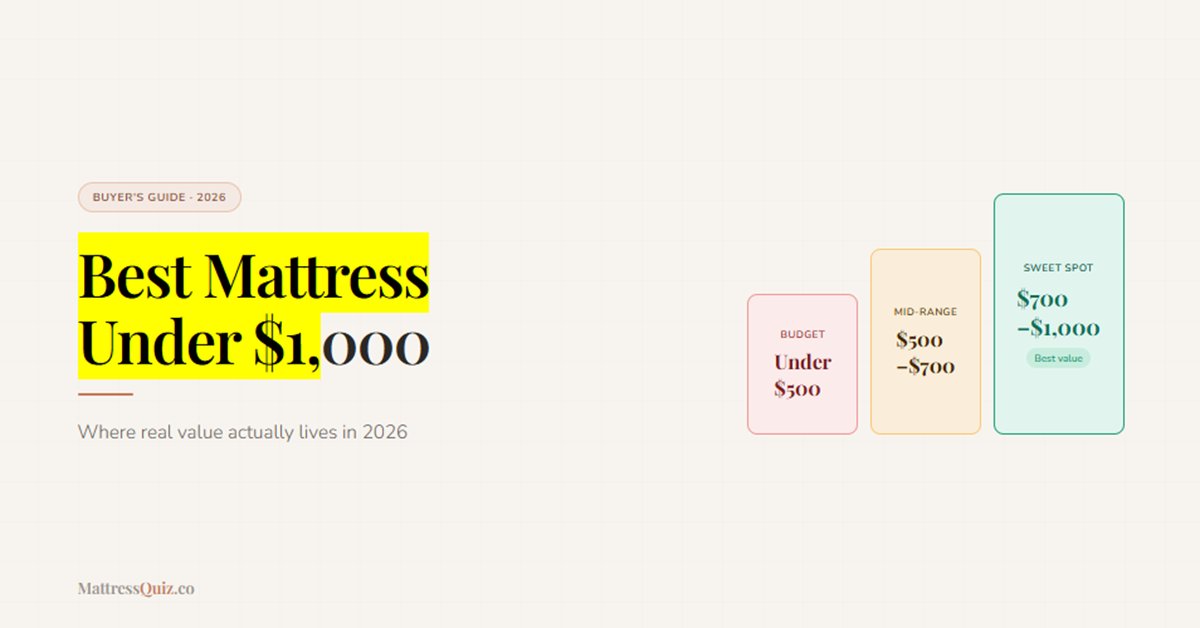
The under-$1,000 price point is where the mattress market gets genuinely interesting.
Below $500, you are accepting tradeoffs. Thin comfort layers, low-density foam, lightweight coil systems, short warranties. The mattress will do the job for a few years and then start to feel like a different mattress entirely.
Above $1,500, you are largely paying for brand positioning, white-glove delivery, luxury cover materials, and features most sleepers will never notice or need.
The $600-$1,000 window is where the best value in the entire mattress market lives. Foam densities increase meaningfully. Coil counts cross the threshold where they start to provide genuine support rather than just bounce.
Trial periods get longer. Warranties become serious. At this price, you are not compromising. You are choosing based on preference.
This guide covers what actually separates quality mattresses at this price from marketing-heavy ones, which brands deliver honest value, and which option fits which type of sleeper.
What Changes About Mattress Quality at This Price
Before looking at specific mattresses, it helps to understand what construction actually improves when you cross from the budget tier into the sub-$1,000 range.
Foam density. Budget mattresses use foam with a density of around 1.2-1.5 lbs per cubic foot. This foam compresses quickly and loses its original feel within 2-3 years of regular use. Quality mattresses at the $600-$1,000 tier use foam at 1.8-2.0 lbs per cubic foot or above. This foam holds its shape and support properties for 7-10 years under normal use. Foam density is the single biggest determinant of mattress longevity and it’s rarely listed in product descriptions.
Coil count and gauge. Budget hybrids often use 400-600 coils in a queen. At this count, the coil spacing is too wide for consistent support. Quality mid-range hybrids use 800-1,000+ individually pocketed coils in a queen. More coils means finer-grained support response, better motion isolation, and better edge support. The coil gauge (wire thickness) also matters: lower gauge numbers mean thicker, firmer wire. Most quality mid-range hybrids use 14-15 gauge coils.
Comfort layer depth. Budget mattresses often have 1-1.5 inches of comfort material over the support core. This is not enough for meaningful pressure relief for side sleepers. Quality mattresses at this tier typically offer 2-4 inches of comfort layers, which is enough to genuinely relieve shoulder and hip pressure.
Trial periods and warranties. Budget mattresses commonly offer 30-100 night trials. At the $600-$1,000 tier, 100-365 night trials become standard. Warranties extend from 1-5 years to 10 years or lifetime. These are not just marketing numbers. A brand confident enough in their construction to offer a lifetime warranty is building differently than one offering a 5-year warranty.
The Sale Price Reality
Almost every mattress at this tier is listed at a higher regular price and perpetually discounted. Understanding this saves you money and prevents you from overpaying.
DreamCloud, Nectar, and Bear all have regular queen prices above $1,000 for their main models. Their actual selling prices — the price they charge almost every day — are in the $649-$999 range for queen. The “regular” price is largely a reference point for the sale discount to look impressive.
The practical implication: never pay the listed regular price for a mattress in this category. Sign up for the brand’s email list and you will typically receive a 20-30% discount code within 24-48 hours. Major sale events (Memorial Day, Labor Day, Black Friday, Presidents’ Day) often bring additional discounts of 25-40% on top of the already-reduced prices.
DreamCloud in particular is worth timing. Their standard sale queen price is around $649-$799, but during major sale events it has dropped to $599. For the construction you get at that price, there is nothing comparable in the market.
The Best Mattresses Under $1,000
These are our picks from our affiliate lineup, organised by who each option suits best.
DreamCloud Hybrid: Best Overall Under $1,000
The DreamCloud Hybrid is our top recommendation in this price range for most sleeper profiles, and it’s not a close call.
At its sale price of $649-$799 for a queen, it delivers a Euro-top comfort layer, a pocketed coil support system with a coil count that sits comfortably above the quality threshold, and a cashmere-blend cover that most mattresses at this price don’t include. The 365-night trial is the longest in this price bracket. The lifetime warranty is matched by almost nothing else at this price.
It sits at medium-firm (6/10), which works for back sleepers, side sleepers in the 150-240 lb range, and combo sleepers. It is not the right choice for side sleepers under 150 lbs who need softer contouring, or for anyone with serious heat problems since the Euro-top does retain warmth.
For everything else, this is the right starting point.
Queen price: $649-$799 (sale), $1,299 (regular). Trial: 365 nights. Best for: Back sleepers, combo sleepers, side sleepers 150-240 lbs, most profiles in the US.
Helix Midnight: Best for Side Sleepers Under $1,000
The Helix Midnight regularly comes in at $899-$1,049 for a queen with the discount codes Helix distributes readily. For side sleepers specifically, the construction justifies every dollar of the premium over DreamCloud.
The comfort layer is specifically tuned for shoulder and hip pressure relief in a way that general-purpose hybrids simply are not. The coil gauge differs by zone, softer under the shoulders and firmer under the lumbar. For side sleepers with hip or shoulder pressure issues, this targeted construction solves a problem that a standard medium hybrid only partially addresses.
If you sleep primarily on your side and you’re in the 130-230 lb range, this is the right mattress in this price category. The 100-night trial is shorter than DreamCloud’s, but Helix has an unusually straightforward return process.
Queen price: $899-$1,049 (with code). Trial: 100 nights. Best for: Side sleepers 130-230 lbs, hip and shoulder pressure pain, combo sleepers who spend most time on their side.
Nectar Premier Copper: Best Foam Feel Under $1,000
For sleepers who specifically want the deep contouring feel of memory foam, the Nectar Premier Copper is the best option in this price range.
At $799-$999 for a queen, it combines copper-infused memory foam with a pocketed coil base. The copper infusion provides modest heat management, and the coil base provides better support than an all-foam mattress at the same price. The result is the feel of memory foam without the full heat retention problem of all-foam construction.
The 365-night trial matches DreamCloud’s and is genuinely one of the best risk-reduction tools in the industry. If the mattress is wrong, you have a year to find out.
Best for side sleepers under 210 lbs who prefer foam contouring. Not the right choice for hot sleepers (copper helps modestly) or anyone over 210 lbs.
Queen price: $799-$999. Trial: 365 nights. Best for: Side sleepers under 210 lbs, foam feel preference, mild heat issues, neutral to cool sleepers.
Tuft & Needle Mint Hybrid: Best for Brand Trust Under $1,000
Tuft & Needle built their reputation on honest, no-nonsense mattresses, and the Mint Hybrid is the product that brings their brand ethos into hybrid construction.
At $895 for a queen, it delivers T&N’s proprietary adaptive foam comfort layer over a pocketed coil base. The foam is more breathable than standard memory foam, making it one of the more honest options for buyers who run slightly warm but are not severe hot sleepers. The construction is straightforward with no exaggerated marketing claims about cooling infusions.
The real differentiator is availability. Tuft & Needle sells through Target stores in the US, which means you can visit the store, lie on the mattress before buying, and still take advantage of the 100-night trial for online purchase. For buyers who are uncomfortable buying a mattress without trying it, this is a meaningful advantage.
Queen price: $895. Trial: 100 nights. Best for: Side and back sleepers 130-220 lbs, buyers who value brand integrity, warm-neutral sleepers, in-store testing preference.
Bear Star Hybrid: Best for Hot Sleepers Under $1,000
Bear Star Hybrid regularly hits $849-$1,099 for a queen and is a strong buy within this range for hot sleepers specifically.
As covered in our hot sleepers guide, the Celliant cover and pocketed coil construction address the heat problem at two levels: surface temperature management through Celliant’s infrared energy conversion and passive airflow through the coil core. For a hot sleeper who has been buying foam mattresses or standard hybrids without addressing the root construction problem, the Bear Star makes a clear difference.
It is only available in the US and the cooling benefits are best used by someone who actually sleeps hot. If temperature is not your problem, the cooling premium is wasted.
Queen price: $849-$1,099 (check current pricing, Bear runs frequent promotions). Trial: 120 nights. Best for: Hot sleepers, active lifestyle buyers, 130-250 lbs, any sleep position.
Leesa Original Hybrid: Best for Values-Driven Buyers Under $1,000
At $749-$999 for a queen, the Leesa Original Hybrid sits comfortably in this price range and performs solidly as a mid-range hybrid. But what converts buyers who are aware of it is the brand’s social mission.
For every 10 mattresses sold, Leesa donates one to a shelter, school, or community organisation in need. This is a documented, verified program, not a vague pledge. For buyers who want their purchase to do something beyond being a mattress, this is a meaningful differentiator over functionally similar hybrids at the same price.
The mattress itself is a capable mid-range hybrid with responsive foam over pocketed coils, suitable for side, back, and combo sleepers in the 130-220 lb range. Not purpose-built for any specific problem, but a strong all-rounder.
Queen price: $749-$999. Trial: 100 nights. Best for: Social-impact-minded buyers, 130-220 lbs, side/back/combo sleepers, buyers in US and UK.
Sub-$500 vs $500-$700 vs $700-$1,000: What You’re Actually Buying
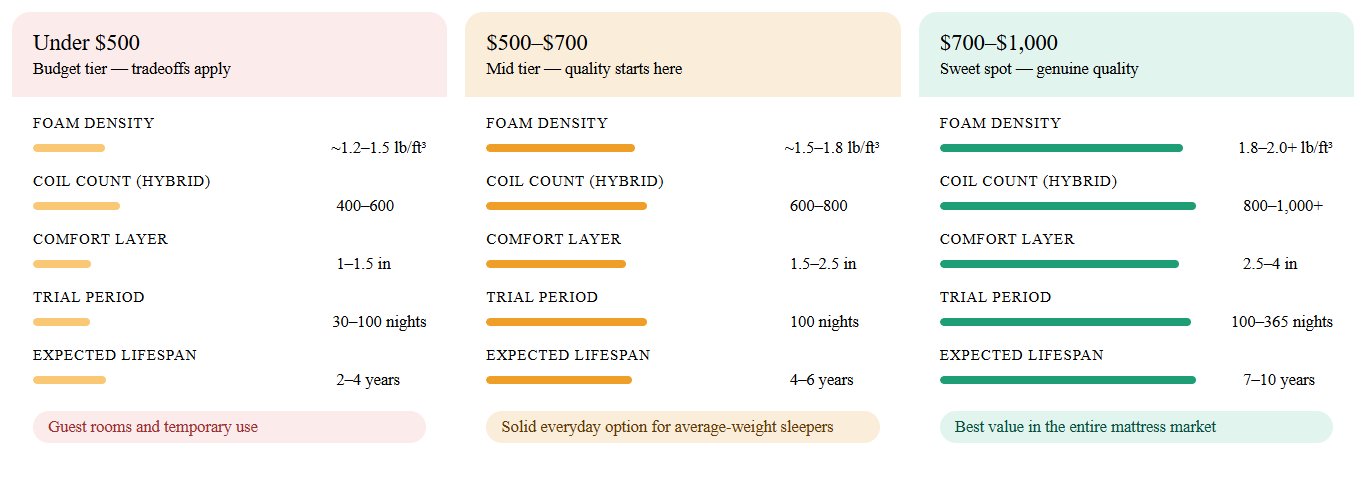
These three sub-tiers within “under $1,000” behave very differently.
Under $500 (Allswell, Zinus, Linenspa, Lucid): You’re in the compromise zone. These mattresses work for guest rooms, temporary use, and buyers whose absolute budget ceiling is $500. Expect thinner comfort layers, lower foam density, lighter coil systems, and 30-100 night trials. A quality mattress in this range for regular use is not realistic. Allswell Hybrid at $299-$395 is the best construction at this price point.
$500-$700 (Tuft & Needle Original, lower end of DreamCloud sale pricing): The entry point to genuinely good mattresses. Tuft & Needle Original at $595-$695 is the best all-foam option at this tier. When DreamCloud goes on sale to $649, it’s an exceptional hybrid at this price that no dedicated $650 mattress can touch.
$700-$1,000 (DreamCloud, Helix, Nectar, Bear, Leesa): This is the genuine sweet spot. You have access to purpose-built hybrids with meaningful trials, warranty protection, and construction quality that will last 7-10 years. Almost every recommendation in this guide lives in this sub-tier.
When You Should Spend More Than $1,000
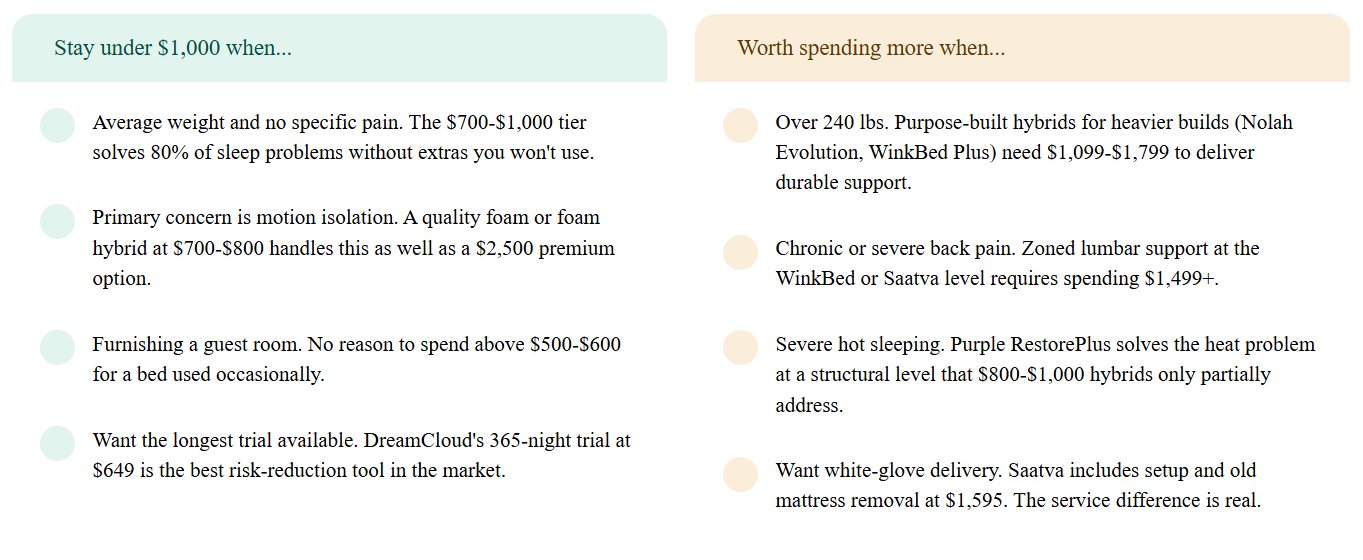
There are four situations where the upgrade beyond $1,000 is worth it and four where it is not.
Worth it:
- You are over 240 lbs. Purpose-built construction for heavier builds (Nolah Evolution 15, WinkBed Plus) requires spending $1,099-$1,799 to get durable, weight-appropriate support.
- You have chronic back pain requiring zoned lumbar support. WinkBed at $1,499 and Saatva Classic at $1,595 deliver construction that sub-$1,000 hybrids don’t match.
- You want white-glove delivery and setup. Saatva includes this at $1,595 and the service difference is real.
- You sleep hot and need maximum cooling. Purple RestorePlus at $2,499+ solves the problem that $800-$1,000 hybrids only partially address.
Not worth it:
- You want a famous brand name. Casper and Tempur-Pedic at premium prices solve the same problems as mid-range hybrids for most average-weight sleepers.
- You want fancier materials in the cover. Cashmere, organic cotton, and copper threading are real materials but their contribution to sleep quality is marginal for most sleepers.
- Your main concern is motion isolation. A quality foam mattress or foam hybrid at $700-$800 handles motion isolation as well as a $2,500 premium option.
- You’re furnishing a guest room or secondary use. There is no reason to spend above $500-$600 for a bed that gets used occasionally.
Frequently Asked Questions
What is the best mattress under $1,000?
DreamCloud Hybrid at its sale price of $649-$799 for a queen is the strongest overall value at this price point for most sleepers. It combines a Euro-top comfort layer, quality pocketed coil construction, a lifetime warranty, and the longest trial period in this price range at 365 nights. For side sleepers specifically, the Helix Midnight at $899-$1,049 with a discount code is more purpose-suited.
Is it possible to get a good mattress for under $1,000?
Yes, and most people do not need to spend more than this. The $700-$1,000 range represents genuine quality, not just acceptable quality. Foam densities, coil counts, and warranty coverage all improve meaningfully compared to the budget tier, and the best options at this price provide 7-10 year lifespans under regular use.
Are mattress sales worth waiting for?
Yes, but within reason. DreamCloud, Nectar, and Bear all run sales consistently around major US holidays (Memorial Day, Labor Day, Black Friday, Presidents’ Day) that reduce prices by 25-40% beyond already-discounted prices. If you are within 4-6 weeks of a major holiday, waiting can save $150-$300 on a queen. If you need a mattress now, signing up for the brand’s email list typically delivers a 20-30% discount code within 24-48 hours.
What mattress under $1,000 is best for back pain?
DreamCloud Hybrid handles mild back pain well for most average-weight sleepers through its coil support core and Euro-top balance. For chronic or specific lower back pain requiring zoned lumbar support, the under-$1,000 range has limited specialised options. WinkBed at $1,499 is the recommended step-up for serious back pain sufferers.
Is a hybrid or memory foam mattress better under $1,000?
At the $700-$1,000 price point, hybrids generally offer better value than all-foam options because the coil core provides better airflow, longer-lasting support, and better edge support at comparable quality levels. All-foam options like Tuft & Needle Original and Nectar are still strong purchases at this price, particularly for motion isolation and foam feel preference, but the hybrid options at the same price typically outperform them for most sleepers.
Find Your Specific Pick
Budget bracket alone does not determine the right mattress. Your body weight, sleep position, heat sensitivity, and whether you share the bed all change which option within this price range best suits your profile.
Our mattress quiz factors all of this in and gives you a specific recommendation with honest reasoning in about two minutes.
[Take the free quiz at MattressQuiz.co]
Affiliate disclosure: Some links in this article are affiliate links. We earn a small commission if you purchase through them at no extra cost to you. It never influences which products we recommend.
Mattress quiz finder
Find the mattress that fits you
Answer a few questions about how you sleep. Get scored matches from our catalog—not a generic roundup.
Start the free quiz